Search News
Industry Portal
Hot Articles
- How Factories Can Select Air Quality Controls for Dust, Fumes, and VOCsIndustrial air quality control for factories: learn how to select effective solutions for dust, fumes, and VOCs while improving safety, compliance, energy efficiency, and uptime.
- How to Size Industrial Gas Scrubbing Units for Acid Fumes and Variable AirflowsIndustrial gas scrubbing units: learn how to size acid-fume scrubbers for variable airflows, peak loads, chemical demand, pressure drop, and reliable compliance.
- How to Evaluate Industrial Air Quality Control Systems for Dust, Fumes, and VOCsIndustrial air quality control systems: learn how to evaluate dust, fumes, and VOC solutions by capture efficiency, compliance, maintenance, and lifecycle cost.
Popular Tags
How tight should cleanroom temperature regulation be?
author
Time
Click Count
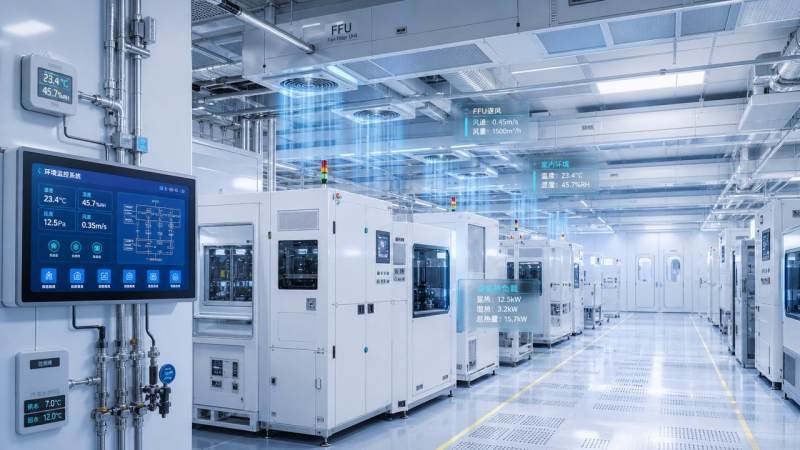
In high-spec cleanrooms, the key issue is not simple control, but how tight cleanroom temperature regulation should be under real operating conditions.
Temperature stability affects yield, airflow behavior, moisture balance, operator comfort, and equipment repeatability at the same time.
As semiconductors, batteries, biotech, and advanced assembly push tighter tolerances, cleanroom temperature regulation has become a strategic design variable, not a background utility.
The best target is rarely the coldest room or the narrowest band.
It is the narrowest practical temperature range that protects process stability without creating unnecessary energy, maintenance, or control-system penalties.
Cleanroom temperature regulation is getting tighter, but not everywhere equally
Many facilities once accepted broad room control, often around ±2°C.
Today, critical spaces increasingly target ±0.5°C, ±0.3°C, or even tighter local stability near tools.
This shift does not mean every cleanroom needs ultra-tight regulation.
It means temperature control is now matched more closely to process sensitivity, contamination risk, and energy intensity.
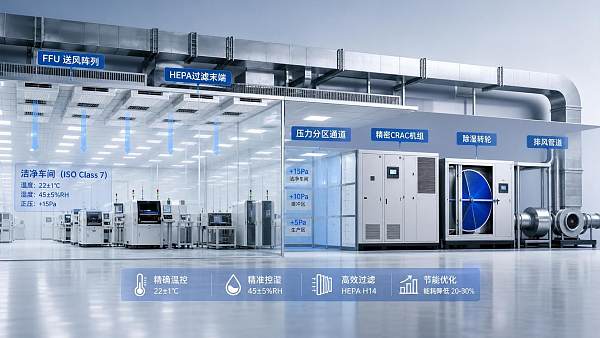
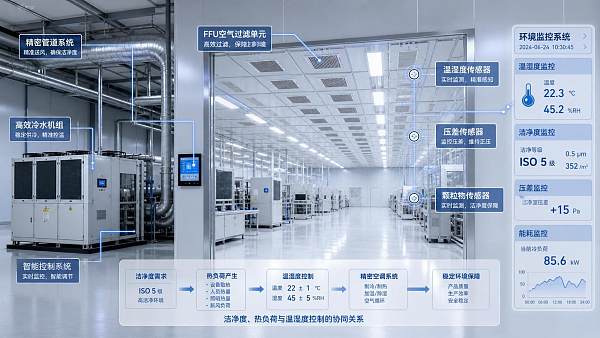
In modern fabs and dry rooms, cleanroom temperature regulation is also linked with dew point control, FFU airflow uniformity, and tool heat rejection.
That interaction changes how tolerances should be defined.
The strongest trend signals come from process stability and energy accountability
Two industry signals are clear.
First, manufacturing steps are becoming more thermally sensitive.
Second, energy budgets and carbon reporting are forcing justification for every extra degree of precision.
This makes cleanroom temperature regulation a balance between quality risk and operating cost.
Key forces shaping tighter control expectations
How tight should cleanroom temperature regulation be in practice?
There is no universal number.
The right answer depends on what failure looks like in that room.
For some areas, product quality suffers before people notice discomfort.
In other areas, a wider band causes no measurable process loss.
Useful reference bands for decision-making
- ±2°C: Often acceptable for general support clean areas and less sensitive assembly zones.
- ±1°C: Common for many regulated cleanrooms needing stable comfort and moderate process consistency.
- ±0.5°C: Suitable for high-value electronics, pharma support zones, and tighter metrology environments.
- ±0.3°C or tighter: Usually justified only for highly sensitive tools or mission-critical process steps.
These bands should apply to defined locations and time windows, not vague room averages.
A room can meet a nominal setpoint while still failing the process at the tool face.
That is why cleanroom temperature regulation must be linked to mapping and sensor placement.
Why tighter is not always better for cleanroom temperature regulation
Over-specifying control precision can create hidden problems.
Aggressive tuning may increase valve hunting, reheating cycles, and unstable humidity behavior.
It can also raise maintenance frequency for CRAC units, sensors, dampers, and chilled-water control loops.
In some sites, the cost of ultra-tight cleanroom temperature regulation exceeds the cost of the actual thermal risk.
Common overcontrol mistakes
- Using the same tolerance for gowning, corridors, process bays, and tool enclosures.
- Ignoring heat-load variation across shifts, recipes, or maintenance states.
- Setting tight room bands without matching humidity and airflow capability.
- Relying on a few wall sensors instead of mapped process-relevant points.
The real answer depends on process, airflow, moisture, and thermal load
A practical tolerance should be built from four interacting conditions.
1. Process sensitivity
If dimensional stability, coating viscosity, optical alignment, or reaction kinetics are temperature-sensitive, tighter regulation is justified.
2. Humidity dependence
Cleanroom temperature regulation cannot be separated from humidity control.
A 1°C shift may materially change relative humidity, electrostatic behavior, or moisture absorption.
3. Equipment heat behavior
Dense tools, exhaust systems, and variable utility loads create local temperature drift.
The tighter the target band, the more important zoning and return-air management become.
4. Airflow architecture
FFU layout, ceiling coverage, underfloor return, and room pressurization affect thermal uniformity.
Poor airflow design can make precise cleanroom temperature regulation impossible, regardless of cooling capacity.
The impact spreads across multiple business and operating layers
Temperature tolerance choices influence more than product quality.
They affect energy performance, uptime, documentation, retrofit strategy, and long-term facility flexibility.
- Process quality: Better repeatability, fewer hidden thermal excursions, and more stable yields.
- Facility energy: Tighter bands often increase simultaneous cooling and reheat demand.
- Maintenance burden: More sensors and tighter loops require stronger calibration discipline.
- Expansion readiness: Flexible zoning makes future process upgrades easier.
- Compliance evidence: Clear bands support trend records, investigations, and audit responses.
What deserves the closest attention now
- Define temperature tolerance by process criticality, not by building-wide tradition.
- Measure at process height, near critical tools, and across load variations.
- Align cleanroom temperature regulation with dew point and humidity targets.
- Separate room-average control from local micro-environment control.
- Review whether current CRAC, FFU, and ventilation architecture can actually hold the chosen band.
- Compare the energy cost of tighter control against the financial value of avoided defects.
A practical framework for setting the right regulation band
The most reliable judgment: tight enough to protect yield, loose enough to stay efficient
For most facilities, the right cleanroom temperature regulation target is not the smallest possible tolerance.
It is the tightest band that clearly reduces process risk and remains controllable across real operating loads.
That usually means combining room-level stability with tighter local environmental control where the process truly needs it.
This layered approach supports both environmental precision and lifecycle efficiency.
A strong next step is to review historical trend data, map thermal variation around critical tools, and compare current tolerance bands with actual defect mechanisms.
When cleanroom temperature regulation is defined by evidence instead of assumption, performance, compliance, and energy results improve together.
Recommended News
 Aug 18, 2026How to Evaluate a High-Tech HVAC Manufacturer for Cleanroom and Precision FacilitiesHigh-tech HVAC manufacturer evaluation guide for cleanrooms and precision facilities. Learn how to assess control stability, compliance, serviceability, and long-term operational risk.
 Aug 13, 2026How to Select VAV Airflow Control Systems for Labs and Cleanroom HVAC ProjectsVAV airflow control systems are critical for labs and cleanroom HVAC projects. Discover how to choose the right system for stability, compliance, and energy savings.
 Jul 21, 2026How to Evaluate Cleanroom Equipment Suppliers in the Middle East for New ProjectsCleanroom equipment Middle East supplier selection starts with technical fit, compliance, service, and lifecycle cost. Discover how to evaluate vendors and reduce project risk.
 Jul 19, 2026How to Estimate HVAC Cost for Electronics Manufacturing Cleanrooms and Production AreasElectronics manufacturing HVAC cost explained: learn how cleanroom class, humidity control, filtration, exhaust, and energy recovery shape realistic budgets and smarter project decisions.
 Jul 14, 2026Electronics Cleanroom Systems in Southeast Asia: How to Choose AHU, FFU, and HEPA LevelsElectronics cleanroom systems Southeast Asia: learn how to choose AHU, FFU, and HEPA levels for better yield, humidity control, energy efficiency, and long-term ROI.
 Jul 13, 2026Cleanroom Design Layout Basics: Zoning, Material Flow, and Contamination ControlCleanroom design layout basics explained: learn zoning, material and personnel flow, and contamination control strategies that reduce risk, improve compliance, and support efficient project planning.
 Jul 12, 2026Air Handling Units Supplier Checklist: 7 Specs to Compare Before You BuyAir handling units supplier checklist: compare 7 critical specs before you buy. Learn how to evaluate airflow, filtration, humidity control, efficiency, and compliance to cut risk and lifetime cost.
 Jul 11, 2026Cleanroom Equipment for Pharmaceutical Plants: What to Specify for GMP ComplianceCleanroom equipment for pharmaceutical plants: learn what to specify for GMP compliance, from airflow and HEPA filtration to pressure, humidity, and cleanability by process.
 Jul 11, 2026EU ETS Revision Reaches Cleanroom AHUsEU ETS revision brings Cleanroom AHUs into focus. Learn how the 2026 amendment affects CE DoC disclosure, carbon cost allocation, EPC tenders, and supplier selection before 2027.
 Jul 10, 2026Cleanroom AHU Cost Guide: Price Ranges, Configuration Factors, and Budget PlanningCleanroom AHU cost explained with realistic price ranges, key configuration factors, and budget tips to compare quotes, avoid hidden costs, and plan smarter cleanroom investments.
 Jul 09, 2026How to Select Precision Air Conditioning for Cleanrooms by Temperature, RH, and Particle RiskPrecision air conditioning for cleanrooms: learn how to choose the right system by temperature stability, RH control, and particle risk to protect yield, ensure compliance, and cut lifecycle cost.
![]() Jul 07, 2026How to Select Heat Recovery Ventilation Systems for Cleanrooms by Class and Air Change RateHeat recovery ventilation systems for cleanrooms: learn how to choose by ISO class, air change rate, leakage risk, and energy performance for safer, more efficient cleanroom operation.
Jul 07, 2026How to Select Heat Recovery Ventilation Systems for Cleanrooms by Class and Air Change RateHeat recovery ventilation systems for cleanrooms: learn how to choose by ISO class, air change rate, leakage risk, and energy performance for safer, more efficient cleanroom operation. Jul 06, 2026Semiconductor Clean Air Systems for Wafer Fabs: Key Design Factors for Yield ControlSemiconductor clean air systems for wafer fabs directly affect yield. Explore key design factors in airflow, AMC, humidity, and pressure control to improve fab stability.
 Jul 04, 2026When to Use Cleanroom Design Services: Scope, Deliverables, and Project Handover TipsCleanroom design services: learn when to engage specialists, what deliverables to request, and how smart handover planning reduces risk, protects compliance, and avoids costly rework.
 Jul 02, 2026How HVAC Humidity Stability Affects Yield in Semiconductor ManufacturingSemiconductor manufacturing HVAC humidity stability directly affects yield, ESD risk, contamination control, and uptime. Learn how stable humidity reduces defects and protects fab performance.
 Jul 02, 2026EN 1886:2026 Sets New EU Entry Bar for Cleanroom AHUsEN 1886:2026 raises the EU entry bar for cleanroom AHUs with new CE marking rules on micro-leakage and heat recovery. Learn what exporters, manufacturers, and buyers must do before 2027.
 Jul 01, 2026SEMI Semiconductor Cleanroom Solutions: What to Compare Before Planning a New FabSEMI semiconductor cleanroom solutions compared the right way: evaluate airflow, humidity, filtration, energy, and scalability before planning a new fab to protect yield and avoid costly redesign.
 Jun 30, 2026What a Clean Environment Control Systems Manufacturer Should Provide Beyond Basic HVACClean environment control systems manufacturer selection should go beyond HVAC. Learn how the right partner improves cleanliness, dew point control, compliance, and energy savings.
 Jun 29, 2026What Drives Cleanroom Temperature Control Cost in New Facility Projects?Cleanroom temperature control cost depends on ISO class, humidity precision, heat load, airflow, redundancy, and lifecycle energy use. Learn what truly drives budgets in new facility projects.
 Jun 27, 2026Electronics Cleanroom Systems Cost Breakdown: What Drives CapEx and Operating Expense?Electronics cleanroom systems cost more than equipment alone. Discover what drives CapEx and operating expense, from FFUs and humidity control to compliance, energy use, and lifecycle risk.
 Jun 25, 2026Clean Environment Control Systems vs Traditional HVAC: Which Fits Sensitive Production?Clean environment control systems vs traditional HVAC: discover which solution better protects sensitive production, improves compliance, and reduces costly contamination risk.
 Jun 25, 2026Electronics Cleanroom Solutions: How to Choose FFU, AHU, and HEPA SetupsElectronics cleanroom solutions explained: learn how to choose FFU, AHU, and HEPA setups to improve yield, control airflow, and reduce lifecycle costs.
 Jun 24, 2026Cleanroom Airflow Control vs Pressure Control: What Matters More for Contamination Risk?Cleanroom airflow control vs pressure control: discover which factor has the bigger impact on contamination risk, product protection, compliance, and cleanroom performance.
 Jun 23, 2026How to Set Cleanroom Temperature Regulation for Stable Processes and Product QualityCleanroom temperature regulation starts with process needs, not generic setpoints. Learn how to control temperature, humidity, airflow, and deviations for stable quality and higher yield.