Search News
Industry Portal
Hot Articles
- How Factories Can Select Air Quality Controls for Dust, Fumes, and VOCsIndustrial air quality control for factories: learn how to select effective solutions for dust, fumes, and VOCs while improving safety, compliance, energy efficiency, and uptime.
- How to Size Industrial Gas Scrubbing Units for Acid Fumes and Variable AirflowsIndustrial gas scrubbing units: learn how to size acid-fume scrubbers for variable airflows, peak loads, chemical demand, pressure drop, and reliable compliance.
- How to Evaluate Industrial Air Quality Control Systems for Dust, Fumes, and VOCsIndustrial air quality control systems: learn how to evaluate dust, fumes, and VOC solutions by capture efficiency, compliance, maintenance, and lifecycle cost.
Popular Tags
How cleanroom environmental control affects yield and risk
author
Time
Click Count
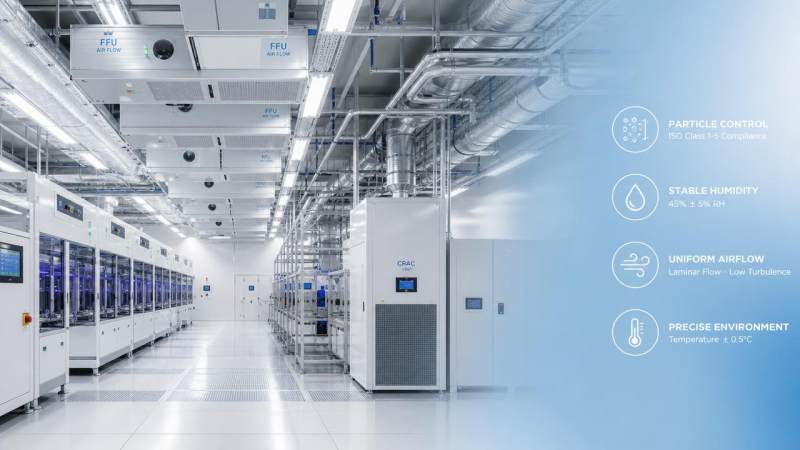
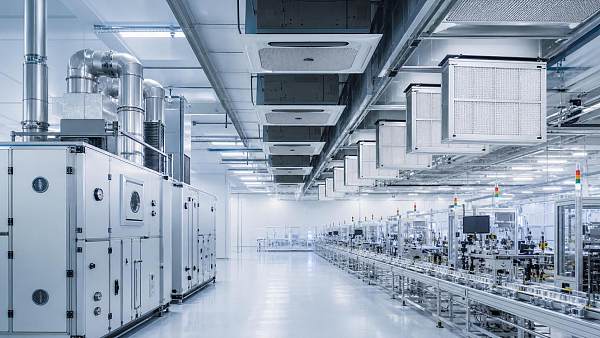
For enterprise decision-makers in semiconductors, batteries, and advanced manufacturing, cleanroom environmental control directly shapes product yield, compliance exposure, and operating cost. From particle suppression and humidity stability to airflow uniformity and energy efficiency, small deviations can trigger major losses. This article explains how tighter environmental control reduces contamination risk, protects process consistency, and creates a measurable competitive advantage.
Why does cleanroom environmental control have such a direct impact on yield?
In high-value manufacturing, yield losses rarely begin as dramatic failures. They usually start with invisible instability: a drifting dew point, uneven laminar flow, pressure imbalance, or a particle spike during shift change.
That is why cleanroom environmental control is not a facility-side afterthought. It is a production variable. When micro-contaminants, moisture, temperature, and exhaust behavior move outside the process window, defect density rises and reproducibility declines.
For decision-makers, the real issue is not only cleanliness. It is the financial relationship between environmental stability and scrap, rework, downtime, warranty exposure, export compliance, and customer qualification.
- Particles can cause pattern defects, coating imperfections, short circuits, sealing failures, and optical contamination.
- Humidity excursions can trigger hydrolysis, lithium material degradation, condensation risk, and dimensional instability.
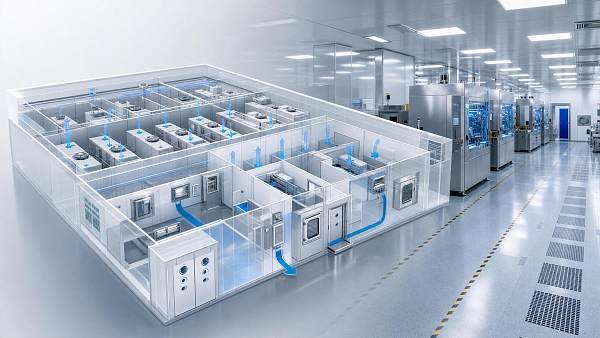
- Airflow non-uniformity can create local turbulence, dead zones, and cross-contamination between critical steps.
- Uncontrolled exhaust and gas treatment can expose operators, delay permits, and increase regulatory risk.
CECS follows these risks from the physics level upward. Its focus on micro-dust isolation, extreme temperature and humidity control, gas treatment, and ventilation intelligence aligns with how yield is actually protected in semiconductor, battery, and precision industrial settings.
What executives should treat as critical process variables
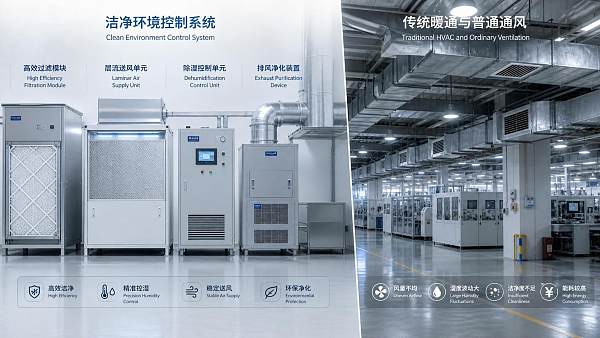
Many teams still manage environmental systems with broad comfort-building logic. That approach fails in advanced production because process rooms are not ordinary HVAC zones. They are controlled environments with narrow tolerance bands.
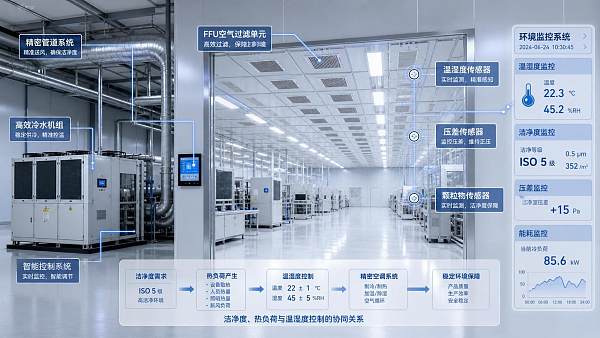
The practical management variables usually include particulate concentration, air change rate, airflow velocity profile, room pressure cascade, temperature drift, relative humidity or dew point, VOC capture efficiency, and recovery time after a disturbance.
Which environmental factors create the highest yield and compliance risk?
The most effective way to discuss cleanroom environmental control is to connect each factor to a business outcome. The table below helps procurement leaders and plant managers prioritize investments based on technical and commercial exposure.
This comparison shows why cleanroom environmental control must be evaluated as a system. A facility can achieve acceptable particle counts yet still lose yield because moisture, flow field behavior, or exhaust treatment remain unstable at process level.
Semiconductors and batteries: similar goals, different control logic
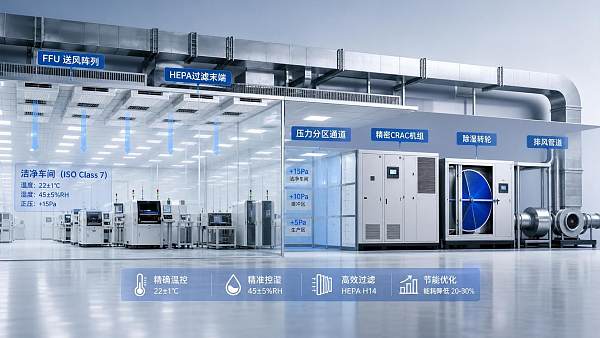
Semiconductor environments prioritize ultrafine particle control, pressure hierarchy, and uniform vertical laminar flow. Battery production often adds extreme dew point management, solvent handling, and stronger integration between process exhaust and safety ventilation.
In both sectors, executives should avoid buying isolated components without verifying system interaction. A strong fan filter unit array cannot compensate for poor room sealing. A high-performance desiccant wheel cannot protect product quality if air recirculation spreads contamination.
How do core technologies reduce contamination risk in real plants?
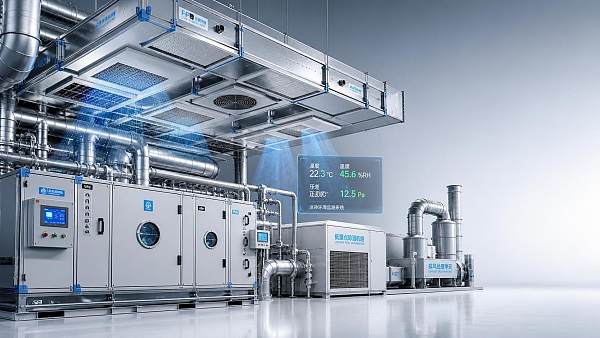
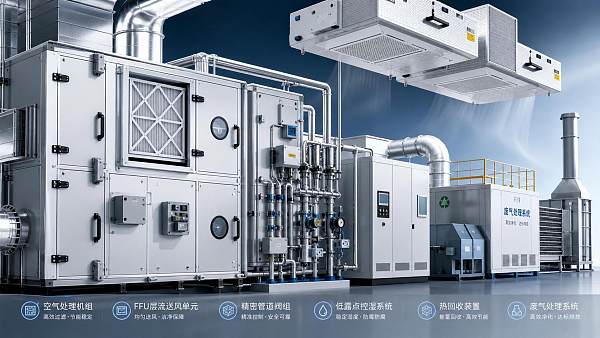
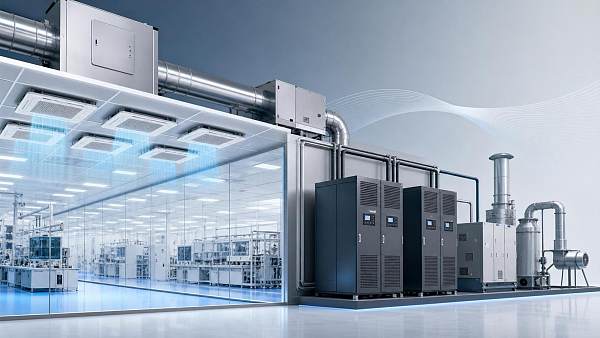
Cleanroom environmental control works when equipment categories are coordinated around the process window. CECS tracks five practical control pillars that matter to both yield and energy performance.
Precision CRAC and extreme humidity control
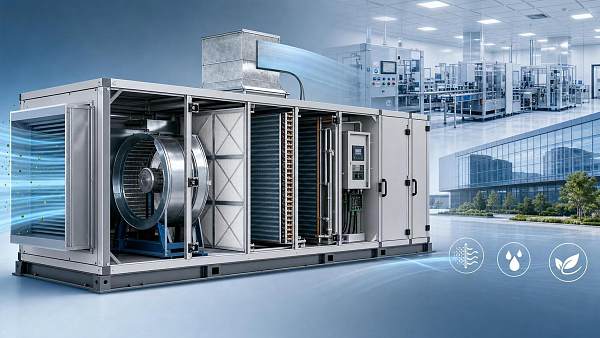
In moisture-sensitive manufacturing, precision CRAC units support stable temperature and latent load management. Where battery coating or reactive chemistry is involved, molecular sieve desiccant systems may be required to maintain very low dew points and reduce hydrolysis risk.
FFU arrays and micro-dust isolation
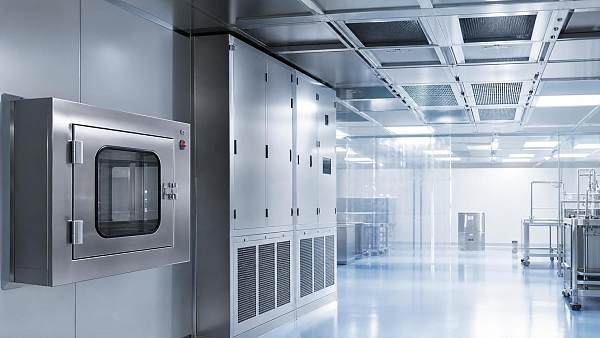
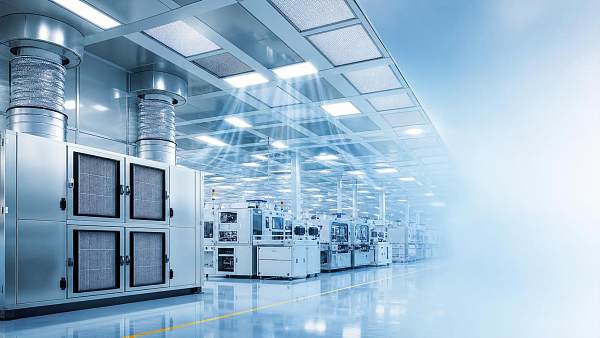
Cleanroom Fan Filter Units act as distributed air delivery points. Their value is not only filtration efficiency. It is also velocity consistency, airflow pattern discipline, noise control, energy draw, maintenance access, and response to zoning changes.
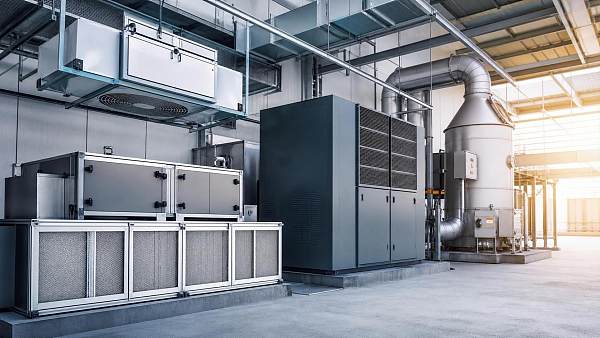
Dust collection, scrubbers, and process exhaust integrity
Chemical, metallurgy, and new energy plants often need more than general room cleanliness. They must remove VOCs, corrosive gases, and fine dust before emissions become a safety or compliance issue. Plasma catalysis, cyclone separation, and wet scrubbing each solve different parts of that challenge.
Workshop ventilation and confined-space safety
Large workshops and tunnels depend on fast, stable air displacement. When welding fumes, solvent vapors, or heat accumulation are present, ventilation must be tied to worker exposure limits, ignition risk, and emergency operating scenarios.
ERV systems and lifecycle energy control
Commercial and mixed-use industrial buildings increasingly evaluate cleanroom environmental control together with energy recovery. ERV systems can reduce HVAC load while supporting indoor air renewal, especially in projects with decarbonization targets or green building certification goals.
What should buyers compare before selecting a cleanroom environmental control solution?
For enterprise buyers, the challenge is rarely finding equipment. The challenge is selecting the right control architecture. The following table is designed as a procurement screening tool for multi-stakeholder decisions involving engineering, EHS, production, and finance teams.
This selection logic helps avoid a common procurement mistake: comparing bids by nameplate capacity while ignoring contamination transport, dew point stability, and long-term operating burden. In advanced manufacturing, the cheapest line item can become the costliest asset.
A practical buyer checklist
- Define the process-critical environmental window before asking for quotations.
- Map contamination sources, moisture ingress points, and exhaust chemistry by area.
- Review airflow path and pressure hierarchy, not only filter grade and air volume.
- Request operating energy assumptions under realistic climate and duty conditions.
- Confirm documentation needed for qualification, audits, and export compliance.
How do standards, certification, and risk governance influence the decision?
A cleanroom project is not only an engineering decision. It is also a governance decision. Auditors, customers, investors, and overseas buyers increasingly expect documented control over contamination, emissions, energy use, and workplace safety.
ISO 14644 remains a key reference for cleanroom classification and performance verification. Depending on project type, decision-makers may also need to align with local EHS rules, indoor air requirements, emission control obligations, and green building frameworks such as LEED-related design targets.
CECS brings value here through intelligence interpretation, not just equipment description. Its Strategic Intelligence Center examines cleanroom standards, thermal recovery logic, and lifecycle cost structures so buyers can connect technical compliance with business viability.
Typical compliance blind spots
- Specifying filtration levels without defining verification and monitoring frequency.
- Treating gas abatement as an end-of-pipe issue rather than a process-integrated requirement.
- Ignoring maintenance access, which leads to performance decline after commissioning.
- Prioritizing initial CapEx while overlooking lifecycle energy penalties and retrofit risk.
Cost, alternatives, and return: where should executives really focus?
The financial case for cleanroom environmental control should be built on avoided loss, stable throughput, and lower compliance friction. Yield protection often delivers more value than visible utility savings, although both matter.
In some projects, buyers compare centralized systems against modular zones, high-density FFU ceilings against selective critical area coverage, or direct exhaust-heavy strategies against energy recovery assisted ventilation. There is no universal answer. The best option depends on process sensitivity, building constraints, expansion plans, and local energy prices.
A disciplined business case should include scrap reduction potential, unplanned downtime exposure, qualification delay risk, maintenance labor, filter replacement intervals, regeneration energy, and the cost of future upgrades. This is especially important when expansion phases are expected.
When a lower-cost alternative may be acceptable
If the process is less moisture-sensitive, less particle-sensitive, or segmented into separate critical islands, a buyer may not need the same level of full-area control used in top-tier semiconductor spaces. However, this decision should be based on contamination mapping and process risk, not on budget pressure alone.
FAQ: what do decision-makers ask most about cleanroom environmental control?
How do we know whether our yield problem is really environmental?
Look for recurring defects that correlate with season, shift change, maintenance events, door opening frequency, production ramp-up, or specific room locations. If defect density rises when humidity drifts, particle counts spike, or airflow balance changes, cleanroom environmental control is likely part of the root cause chain.
What should we ask suppliers before comparing quotations?
Ask how the proposed solution maintains cleanliness class, dew point or humidity stability, airflow uniformity, pressure cascade, and exhaust treatment under actual operating load. Also ask what assumptions were used for climate, occupancy, process exhaust, energy consumption, and maintenance intervals.
Is ISO 14644 enough for project approval?
Not always. ISO 14644 is essential for cleanroom classification and testing, but many projects also need alignment with safety, emissions, building, and customer-specific requirements. In export-oriented manufacturing, documentation depth can become as important as hardware performance.
How long does implementation usually take?
It depends on scope, customization, and regulatory review. A targeted retrofit in one production zone may move much faster than a full new-build facility with dehumidification, FFU arrays, scrubbers, and integrated energy recovery. Decision-makers should request a milestone plan covering design confirmation, manufacturing, site readiness, commissioning, and validation support.
Why work with CECS when planning or upgrading cleanroom environmental control?
CECS is positioned for buyers who need more than a catalog view. Its coverage spans industrial micro-dust isolation, ultra-low dew point control, zero-emission gas treatment, workshop ventilation, and commercial heat recovery ventilation. That matters because modern projects increasingly blend production quality goals with compliance and energy objectives.
The advantage is analytical depth across the full system chain. From ISO 14644 interpretation and airflow field logic to thermal recovery economics and export-facing compliance questions, CECS helps decision-makers stitch technical details into clearer investment judgment.
If you are reviewing cleanroom environmental control for a new facility or retrofit, you can consult on specific topics such as target cleanliness and dew point parameters, FFU and CRAC selection logic, exhaust and scrubber route planning, energy recovery options, certification documentation needs, expected delivery stages, and quotation comparison points. For projects under time pressure, early parameter confirmation often prevents the most expensive redesigns later.
Recommended News
 Aug 18, 2026How to Evaluate a High-Tech HVAC Manufacturer for Cleanroom and Precision FacilitiesHigh-tech HVAC manufacturer evaluation guide for cleanrooms and precision facilities. Learn how to assess control stability, compliance, serviceability, and long-term operational risk.
 Aug 13, 2026How to Select VAV Airflow Control Systems for Labs and Cleanroom HVAC ProjectsVAV airflow control systems are critical for labs and cleanroom HVAC projects. Discover how to choose the right system for stability, compliance, and energy savings.
 Jul 21, 2026How to Evaluate Cleanroom Equipment Suppliers in the Middle East for New ProjectsCleanroom equipment Middle East supplier selection starts with technical fit, compliance, service, and lifecycle cost. Discover how to evaluate vendors and reduce project risk.
 Jul 19, 2026How to Estimate HVAC Cost for Electronics Manufacturing Cleanrooms and Production AreasElectronics manufacturing HVAC cost explained: learn how cleanroom class, humidity control, filtration, exhaust, and energy recovery shape realistic budgets and smarter project decisions.
 Jul 14, 2026Electronics Cleanroom Systems in Southeast Asia: How to Choose AHU, FFU, and HEPA LevelsElectronics cleanroom systems Southeast Asia: learn how to choose AHU, FFU, and HEPA levels for better yield, humidity control, energy efficiency, and long-term ROI.
 Jul 13, 2026Cleanroom Design Layout Basics: Zoning, Material Flow, and Contamination ControlCleanroom design layout basics explained: learn zoning, material and personnel flow, and contamination control strategies that reduce risk, improve compliance, and support efficient project planning.
 Jul 12, 2026Air Handling Units Supplier Checklist: 7 Specs to Compare Before You BuyAir handling units supplier checklist: compare 7 critical specs before you buy. Learn how to evaluate airflow, filtration, humidity control, efficiency, and compliance to cut risk and lifetime cost.
 Jul 11, 2026Cleanroom Equipment for Pharmaceutical Plants: What to Specify for GMP ComplianceCleanroom equipment for pharmaceutical plants: learn what to specify for GMP compliance, from airflow and HEPA filtration to pressure, humidity, and cleanability by process.
 Jul 11, 2026EU ETS Revision Reaches Cleanroom AHUsEU ETS revision brings Cleanroom AHUs into focus. Learn how the 2026 amendment affects CE DoC disclosure, carbon cost allocation, EPC tenders, and supplier selection before 2027.
 Jul 10, 2026Cleanroom AHU Cost Guide: Price Ranges, Configuration Factors, and Budget PlanningCleanroom AHU cost explained with realistic price ranges, key configuration factors, and budget tips to compare quotes, avoid hidden costs, and plan smarter cleanroom investments.
 Jul 09, 2026How to Select Precision Air Conditioning for Cleanrooms by Temperature, RH, and Particle RiskPrecision air conditioning for cleanrooms: learn how to choose the right system by temperature stability, RH control, and particle risk to protect yield, ensure compliance, and cut lifecycle cost.
![]() Jul 07, 2026How to Select Heat Recovery Ventilation Systems for Cleanrooms by Class and Air Change RateHeat recovery ventilation systems for cleanrooms: learn how to choose by ISO class, air change rate, leakage risk, and energy performance for safer, more efficient cleanroom operation.
Jul 07, 2026How to Select Heat Recovery Ventilation Systems for Cleanrooms by Class and Air Change RateHeat recovery ventilation systems for cleanrooms: learn how to choose by ISO class, air change rate, leakage risk, and energy performance for safer, more efficient cleanroom operation. Jul 06, 2026Semiconductor Clean Air Systems for Wafer Fabs: Key Design Factors for Yield ControlSemiconductor clean air systems for wafer fabs directly affect yield. Explore key design factors in airflow, AMC, humidity, and pressure control to improve fab stability.
 Jul 04, 2026When to Use Cleanroom Design Services: Scope, Deliverables, and Project Handover TipsCleanroom design services: learn when to engage specialists, what deliverables to request, and how smart handover planning reduces risk, protects compliance, and avoids costly rework.
 Jul 02, 2026How HVAC Humidity Stability Affects Yield in Semiconductor ManufacturingSemiconductor manufacturing HVAC humidity stability directly affects yield, ESD risk, contamination control, and uptime. Learn how stable humidity reduces defects and protects fab performance.
 Jul 02, 2026EN 1886:2026 Sets New EU Entry Bar for Cleanroom AHUsEN 1886:2026 raises the EU entry bar for cleanroom AHUs with new CE marking rules on micro-leakage and heat recovery. Learn what exporters, manufacturers, and buyers must do before 2027.
 Jul 01, 2026SEMI Semiconductor Cleanroom Solutions: What to Compare Before Planning a New FabSEMI semiconductor cleanroom solutions compared the right way: evaluate airflow, humidity, filtration, energy, and scalability before planning a new fab to protect yield and avoid costly redesign.
 Jun 30, 2026What a Clean Environment Control Systems Manufacturer Should Provide Beyond Basic HVACClean environment control systems manufacturer selection should go beyond HVAC. Learn how the right partner improves cleanliness, dew point control, compliance, and energy savings.
 Jun 29, 2026What Drives Cleanroom Temperature Control Cost in New Facility Projects?Cleanroom temperature control cost depends on ISO class, humidity precision, heat load, airflow, redundancy, and lifecycle energy use. Learn what truly drives budgets in new facility projects.
 Jun 27, 2026Electronics Cleanroom Systems Cost Breakdown: What Drives CapEx and Operating Expense?Electronics cleanroom systems cost more than equipment alone. Discover what drives CapEx and operating expense, from FFUs and humidity control to compliance, energy use, and lifecycle risk.
 Jun 25, 2026Clean Environment Control Systems vs Traditional HVAC: Which Fits Sensitive Production?Clean environment control systems vs traditional HVAC: discover which solution better protects sensitive production, improves compliance, and reduces costly contamination risk.
 Jun 25, 2026Electronics Cleanroom Solutions: How to Choose FFU, AHU, and HEPA SetupsElectronics cleanroom solutions explained: learn how to choose FFU, AHU, and HEPA setups to improve yield, control airflow, and reduce lifecycle costs.
 Jun 24, 2026Cleanroom Airflow Control vs Pressure Control: What Matters More for Contamination Risk?Cleanroom airflow control vs pressure control: discover which factor has the bigger impact on contamination risk, product protection, compliance, and cleanroom performance.
 Jun 23, 2026How to Set Cleanroom Temperature Regulation for Stable Processes and Product QualityCleanroom temperature regulation starts with process needs, not generic setpoints. Learn how to control temperature, humidity, airflow, and deviations for stable quality and higher yield.