Search News
Industry Portal
Hot Articles
- ISO 14644 Certification Process: From Cleanroom Testing to Compliance ApprovalISO 14644 certification process explained: prepare your cleanroom, complete particle testing, address failures, and achieve compliance approval with confidence.
- How Factories Can Select Air Quality Controls for Dust, Fumes, and VOCsIndustrial air quality control for factories: learn how to select effective solutions for dust, fumes, and VOCs while improving safety, compliance, energy efficiency, and uptime.
- How to Size Industrial Gas Scrubbing Units for Acid Fumes and Variable AirflowsIndustrial gas scrubbing units: learn how to size acid-fume scrubbers for variable airflows, peak loads, chemical demand, pressure drop, and reliable compliance.
Popular Tags
EU Mandates Dual ATEX + EN 14986 Certification for Tunnel Ventilation Fans
author
Time
Click Count
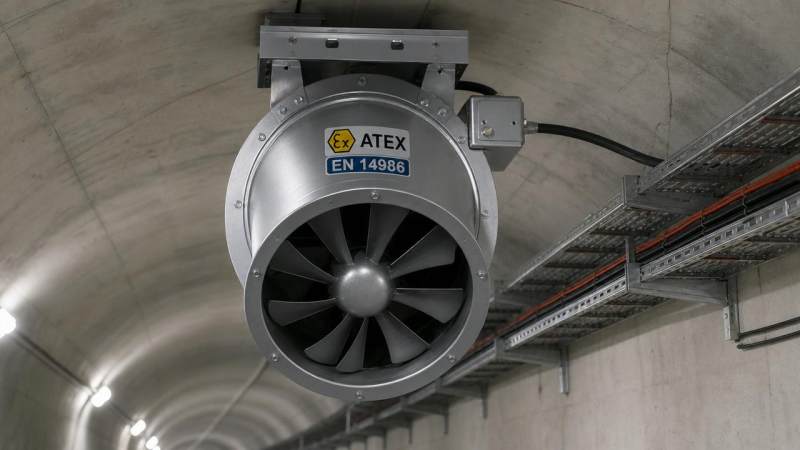
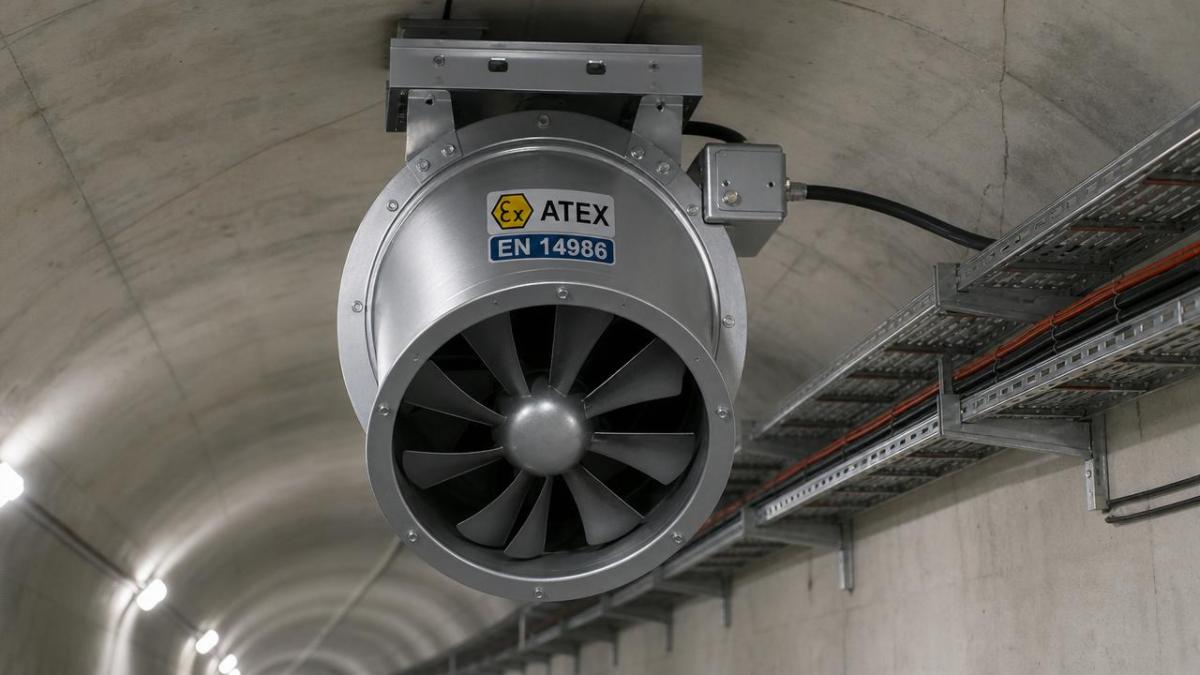
The European Commission officially implemented Regulation (EU) 2026/892 on 21 May 2026, imposing new mandatory conformity requirements for jet fans and explosion-proof axial fans deployed in tunnels, underground utility corridors, and other confined spaces—directly impacting manufacturers, exporters, and infrastructure contractors operating in the EU market.
New Regulatory Requirement Enters Force
As of 21 May 2026, Regulation (EU) 2026/892 requires all jet fans for tunnels and explosion-proof axial fans intended for use in tunnels and underground utility corridors to hold both ATEX Directive 2014/34/EU certification (covering equipment design for explosive atmospheres) and EN 14986:2025 certification (specifying performance, safety, and operational requirements for tunnel ventilation fans). A 90-day transition period remains in effect; products lacking both certifications will be prohibited from customs clearance into the EU after expiry.
Impact Across the Supply Chain
Export-oriented manufacturers
Manufacturers exporting tunnel ventilation equipment to the EU must now align product design, testing, and documentation with two distinct regulatory frameworks. This affects type examination, technical file compilation, and notified body engagement—especially where legacy ATEX-certified models lack EN 14986:2025 validation for tunnel-specific fire-resistance, airflow stability under high-temperature conditions, and emergency operation modes.
Raw material and component suppliers
Suppliers of critical components—including flameproof motor housings, high-temperature bearings, and certified control modules—must verify that their parts meet the combined mechanical, thermal, and electrical safety thresholds referenced in both ATEX and EN 14986:2025. Traceability documentation (e.g., material certificates, test reports) must explicitly support dual-conformity claims.
Contract manufacturers and OEMs
OEMs integrating third-party fans into tunnel ventilation systems face cascading compliance obligations. System-level CE marking now depends on verified dual certification of embedded fans—not just subsystem declarations. Requalification of existing installations may be triggered during major maintenance or upgrade tenders referencing post-2026 specifications.
Logistics and certification service providers
Certification bodies, test laboratories, and customs brokers must update guidance and pre-clearance checklists to reflect the mandatory co-application of ATEX and EN 14986:2025. Delays are anticipated in issuing combined assessment reports, particularly for products requiring retesting against updated EN 14986:2025 clauses on smoke extraction efficiency and electromagnetic compatibility under fire conditions.
Key Compliance Actions for Enterprises
Immediate dual-certification gap assessment
Companies must audit current product portfolios to identify units certified under ATEX only—or EN 14986 only—and initiate parallel conformity assessments. Notified bodies authorized for both schemes (e.g., DEKRA, SGS, TÜV Rheinland) should be engaged without delay given limited capacity ahead of the 90-day deadline.
Revision of technical tender documentation
Technical bids for EU-funded infrastructure projects—including those under CEF (Connecting Europe Facility) or national transport programmes—must now explicitly reference compliance with both ATEX 2014/34/EU and EN 14986:2025. Legacy references to EN 14986:2017 or standalone ATEX declarations will no longer satisfy eligibility criteria.
Supplier qualification and subcomponent traceability
Manufacturers must obtain updated DoCs (Declarations of Conformity), test reports, and EC Type Examination Certificates for all critical subassemblies—including impellers, motors, and explosion-proof enclosures—to ensure full traceability back to dual-certified source materials and processes.
Adjustment of delivery timelines and stock planning
Given typical certification lead times of 12–20 weeks for full dual assessment—including factory audits, sample testing, and report finalization—export schedules must be revised. Holding transitional inventory of pre-certified units is permissible only until the 90-day cut-off; post-deadline shipments require valid dual certification evidence at customs.
Industry Observation: Beyond Compliance, a Shift in Technical Benchmarking
Analysis shows this regulation marks more than a procedural update—it signals a structural convergence of intrinsic safety (ATEX) and application-specific performance (EN 14986). From an industry perspective, EN 14986:2025 introduces quantifiable thresholds for fan survivability in fire scenarios (e.g., 600 °C for 120 minutes), which go beyond traditional ATEX mechanical integrity requirements. What deserves closer attention is how this dual mandate accelerates consolidation among mid-tier manufacturers unable to absorb certification cost increases—estimated at 25–40% per model—while elevating technical due diligence in public procurement evaluations.
Toward Harmonized Safety Standards in Critical Infrastructure
This regulation reflects a broader trend toward harmonizing functional safety with environmental resilience in life-critical infrastructure equipment. While compliance is non-negotiable for market access, its long-term significance lies in raising baseline expectations for reliability, interoperability, and incident response capability—not just in EU tunnels, but as a de facto benchmark for global infrastructure projects adopting EU-aligned specifications.
Source Information and Verification Notes
This article is generated exclusively from the provided title, event date (21 May 2026), and summary text. Specific official source links were not provided in the input and should be verified continuously. Stakeholders are advised to monitor updates from the European Commission’s Official Journal, notified bodies’ implementation bulletins, and upcoming revisions to EN 14986 application guidelines issued by CEN/TC 197. Ongoing observation is recommended regarding enforcement interpretation, transitional documentation allowances, and national-level tender specification updates.
Recommended News
 Aug 29, 2026ISO 14644 Certification Process: From Cleanroom Testing to Compliance ApprovalISO 14644 certification process explained: prepare your cleanroom, complete particle testing, address failures, and achieve compliance approval with confidence.
 Aug 28, 2026How Factories Can Select Air Quality Controls for Dust, Fumes, and VOCsIndustrial air quality control for factories: learn how to select effective solutions for dust, fumes, and VOCs while improving safety, compliance, energy efficiency, and uptime.
 Aug 27, 2026How to Size Industrial Gas Scrubbing Units for Acid Fumes and Variable AirflowsIndustrial gas scrubbing units: learn how to size acid-fume scrubbers for variable airflows, peak loads, chemical demand, pressure drop, and reliable compliance.
 Aug 26, 2026How to Evaluate Industrial Air Quality Control Systems for Dust, Fumes, and VOCsIndustrial air quality control systems: learn how to evaluate dust, fumes, and VOC solutions by capture efficiency, compliance, maintenance, and lifecycle cost.
 Aug 25, 2026How to Select Cleanroom Particle Control Equipment for ISO Class and Process RiskCleanroom particle control equipment selection starts with process risk, ISO class, and airflow design. Learn how to compare FFUs, filters, and monitoring for reliable performance.
 Aug 24, 2026How to Choose a Ducted Heat Recovery Ventilation System for Commercial BuildingsDucted heat recovery ventilation for commercial buildings: learn how to compare efficiency, static pressure, controls, IAQ, and lifecycle cost to choose a smarter, high-performance system.
 Aug 23, 2026How Laminar Airflow Supports Compliance and Contamination Control in Medical Device ManufacturingLaminar airflow for medical devices helps reduce contamination risk, support cleanroom compliance, and improve audit readiness—see how it protects product quality and manufacturing control.
 Aug 22, 2026How to Verify CE Compliance When Comparing VOC Treatment Systems for EU ProjectsVOC treatment systems CE certified: learn how to verify real EU compliance, check directives, ATEX, and documentation, and avoid costly procurement and site integration risks.
 Aug 21, 2026How to Achieve Stable RH Precision Humidity Control in Cleanroom Production?Stable RH precision humidity control starts with process-based design. Learn how airflow, sensors, dehumidification, and recovery logic keep cleanroom production consistent and reliable.
 Aug 20, 2026How to Select Airflow Control Dampers for Pressure Balance and Energy EfficiencyAirflow control dampers selection starts with pressure balance, leakage, and control authority—not duct size alone. Learn how to improve stability and energy efficiency.
 Aug 19, 2026What Drives Cleanroom Compliance Cost in Pharma and Semiconductor Projects?Cleanroom compliance cost in pharma and semiconductor projects depends on ISO class, airflow, humidity control, validation, and energy use. Learn what drives cost and how to avoid costly overdesign.
 Aug 18, 2026How to Evaluate a High-Tech HVAC Manufacturer for Cleanroom and Precision FacilitiesHigh-tech HVAC manufacturer evaluation guide for cleanrooms and precision facilities. Learn how to assess control stability, compliance, serviceability, and long-term operational risk.
 Aug 17, 2026How to Evaluate a Commercial ERV Systems Supplier for Large Building ProjectsCommercial ERV systems supplier selection for large projects goes beyond price. Learn how to compare performance, compliance, controls, delivery, and lifecycle cost to reduce risk.
 Aug 16, 2026Commercial Ventilation Pricing: What Drives Cost in Industrial and Office Projects?Commercial ventilation pricing varies by airflow, compliance, and installation needs. Learn what drives costs in industrial and office projects—and how to compare quotes smarter.
 Aug 16, 2026EU Issues New RTO/RCO Compliance Guide, Adds Carbon and Efficiency CertificationEU releases a new RTO/RCO compliance guide with carbon and efficiency certification requirements, signaling stricter market access rules and urgent action for exporters.
 Aug 15, 2026What Makes an HVAC System Energy-Efficient for European Buildings?Energy efficient HVAC Europe solutions help European buildings cut costs, boost comfort, and meet carbon targets. Discover the design factors that truly improve performance.
 Aug 15, 2026China Issues New Export Compliance Rules for RTO/RCO SystemsChina's new export compliance rules for RTO/RCO systems are reshaping market access. Learn what the 2026 regulations mean for exporters, buyers, and green procurement.
 Aug 14, 2026How to Evaluate a Precision Cooling Supplier for High-Density Data CentersPrecision cooling supplier guide for high-density data centers: learn how to evaluate reliability, scalability, compliance, and lifecycle value before you buy.
 Aug 14, 2026China’s Temporary Helium Export Ban Slows RTO/RCO Core Cooling DeliveriesChina’s temporary helium export ban may delay RTO/RCO core cooling deliveries, especially for final testing and certification. Learn how it impacts projects and what companies should check next.
 Aug 13, 2026How to Select VAV Airflow Control Systems for Labs and Cleanroom HVAC ProjectsVAV airflow control systems are critical for labs and cleanroom HVAC projects. Discover how to choose the right system for stability, compliance, and energy savings.
 Aug 12, 2026How to Select Dew Point Control Systems for Battery Plants?Dew point control systems for battery plants: learn how to compare stability, energy use, controls, and maintenance to choose a safer, more efficient dry room solution.
![]() Aug 12, 2026The EU updates CE guidelines, RTO/RCO need to take into account both energy efficiency and explosion protectionEU CE Guide update: RTO/RCO systems must now meet both energy efficiency and explosion-proof compliance. Learn how EN 1539, ATEX testing, and new VOCs rules impact EU market access.
Aug 12, 2026The EU updates CE guidelines, RTO/RCO need to take into account both energy efficiency and explosion protectionEU CE Guide update: RTO/RCO systems must now meet both energy efficiency and explosion-proof compliance. Learn how EN 1539, ATEX testing, and new VOCs rules impact EU market access. Aug 11, 2026How to Select Precision Humidity Control for Cleanrooms and Micro-EnvironmentsPrecision humidity control for cleanrooms starts with process needs. Learn how to compare dew point targets, airflow, controls, and energy tradeoffs for reliable, high-yield micro-environments.
 Aug 11, 2026China Sets New VOCs Certification Rule for RTO/RCO ExportsChina sets new VOCs certification rule for RTO/RCO exports. Learn how CN-ERV-2026, energy-efficiency grades, and customs impacts could affect bids, buyers, and delivery plans.