Search News
Industry Portal
Hot Articles
- ISO 14644 Certification Process: From Cleanroom Testing to Compliance ApprovalISO 14644 certification process explained: prepare your cleanroom, complete particle testing, address failures, and achieve compliance approval with confidence.
- How Factories Can Select Air Quality Controls for Dust, Fumes, and VOCsIndustrial air quality control for factories: learn how to select effective solutions for dust, fumes, and VOCs while improving safety, compliance, energy efficiency, and uptime.
- How to Size Industrial Gas Scrubbing Units for Acid Fumes and Variable AirflowsIndustrial gas scrubbing units: learn how to size acid-fume scrubbers for variable airflows, peak loads, chemical demand, pressure drop, and reliable compliance.
Popular Tags
UAE ADQ Mandates Sensible/Total Heat ERV in Zero-Carbon Public Buildings
author
Time
Click Count
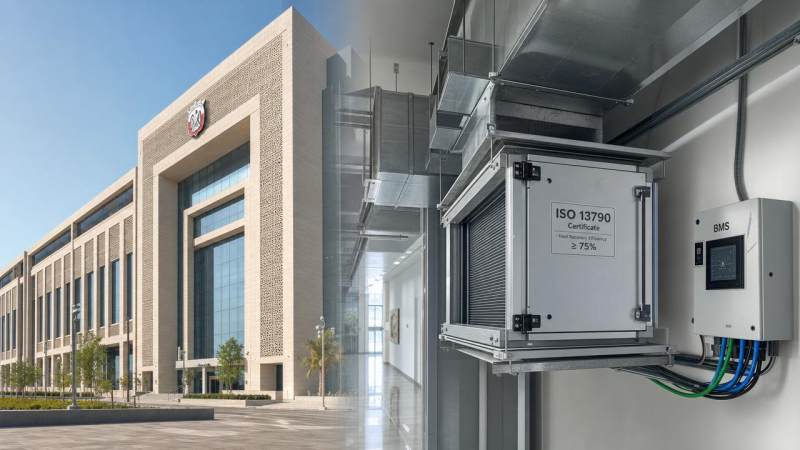
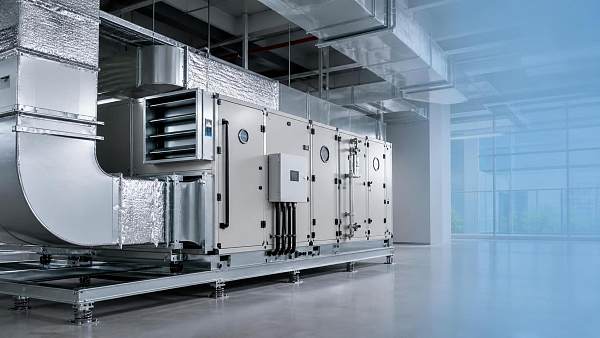
On 28 May 2026, Abu Dhabi Developmental Holding Company (ADQ), a UAE sovereign wealth fund, launched the first tender phase under its National Green Building Acceleration Program, requiring all new government office and healthcare facilities to integrate sensible or total heat energy recovery ventilators (ERV) — with minimum certified heat recovery efficiency of 78% (per ISO 13790) and mandatory integration into a unified building management system (BMS). This development signals immediate implications for HVAC equipment exporters, system integrators, and regional supply chain stakeholders serving the Middle East construction and sustainability sectors.
Event Overview
On 28 May 2026, ADQ published tender documents for the inaugural projects of its National Green Building Acceleration Program. The documents explicitly stipulate that all newly constructed government administrative and medical buildings must be equipped with sensible or total heat ERV systems meeting ≥78% heat recovery efficiency (verified per ISO 13790) and interoperable with a centralized BMS platform. The initiative is projected to unlock over USD 230 million in annual procurement demand for high-performance ERV equipment across the Middle East.
Impact on Specific Industry Segments
Direct Exporters and OEMs of ERV Equipment
This requirement directly affects manufacturers and exporters whose product portfolios include ISO 13790-certified sensible or total heat ERV units. As ADQ’s tender applies to all new government office and healthcare infrastructure, compliance becomes a prerequisite for market access—not just for ADQ-led projects but potentially for cascading adoption across federal and emirate-level public procurement frameworks.
System Integrators and MEP Contractors
Integrators responsible for HVAC-BMS interoperability face tightened technical specifications. The mandate for BMS integration means ERV units must support standardized communication protocols (e.g., BACnet/IP or Modbus TCP), and contractors must demonstrate verified commissioning workflows aligned with ADQ’s digital infrastructure requirements.
Regional Distributors and Channel Partners
Distributors operating in the UAE and wider GCC will experience heightened demand for certified ERV hardware—but also increased scrutiny around documentation, traceability, and post-installation performance verification. Inventory planning and technical support capacity must now align with certified efficiency thresholds and BMS compatibility claims.
Testing, Certification, and Compliance Service Providers
Third-party labs and certification bodies accredited for ISO 13790 testing are likely to see elevated demand for validation services. As ADQ requires certified efficiency data as part of tender submission, pre-submission verification becomes a critical path item—not an optional add-on.
What Relevant Enterprises or Practitioners Should Monitor and Do Now
Track official ADQ clarifications and subsequent tender releases
Analysis shows that this initial tender represents only the first wave; ADQ has indicated plans to expand the mandate to education and residential public-sector projects in Phase II. Stakeholders should monitor ADQ’s official portal and UAE Ministry of Climate Change & Environment (MOCCAE) updates for scope extensions and timeline adjustments.
Prioritize verification of ISO 13790 certification status and BMS protocol alignment
Observably, not all commercially labeled “total heat ERV” units meet the ≥78% threshold under ISO 13790 test conditions. Companies should audit existing product certifications and confirm whether BMS interface documentation (including point lists and driver files) is available for immediate submission.
Distinguish between policy signal and operational readiness
From industry perspective, the mandate is a binding procurement condition—not a guideline. However, actual project award timelines, enforcement mechanisms (e.g., penalties for non-compliance), and audit frequency remain unspecified. Firms should treat the requirement as enforceable from tender submission onward, while treating implementation details as subject to ongoing clarification.
Prepare technical documentation packages and cross-functional coordination
Current more practical response includes assembling pre-validated submittal dossiers: ISO 13790 test reports, BMS integration schematics, commissioning checklists, and local after-sales service commitments. Cross-departmental alignment between sales, engineering, and regulatory affairs teams is essential ahead of bid deadlines.
Editorial Perspective / Industry Observation
This move is better understood as a structural procurement signal—not merely a one-off tender condition. Analysis shows ADQ is leveraging its role as a major public-sector developer to de facto standardize high-efficiency ERV deployment across institutional buildings. While the immediate impact is confined to ADQ-managed projects, its influence is likely to extend through emulation by other UAE entities (e.g., Abu Dhabi Municipality, Department of Health) and regional peers seeking alignment with UAE Net Zero by 2050 targets. Observably, the emphasis on certified performance (not just nominal specs) and system-level interoperability reflects a maturing phase in Middle East green building policy—shifting from aspiration to verifiable technical enforcement.
Conclusion
The ADQ mandate does not create a new market, but it materially accelerates specification-driven demand for certified sensible/total heat ERV systems in the Middle East public construction sector. It is best interpreted not as an isolated regulatory update, but as an early indicator of tightening technical baselines for ventilation equipment in climate-resilient infrastructure. For stakeholders, proactive alignment with ISO 13790 verification and BMS integration readiness—not speculative market entry—is the most operationally relevant response at this stage.
Source: Official tender documents released by Abu Dhabi Developmental Holding Company (ADQ) on 28 May 2026, under the National Green Building Acceleration Program.
Note: Further rollout scope, enforcement protocols, and Phase II timelines remain under observation and are not yet publicly confirmed.
Recommended News
 Aug 29, 2026ISO 14644 Certification Process: From Cleanroom Testing to Compliance ApprovalISO 14644 certification process explained: prepare your cleanroom, complete particle testing, address failures, and achieve compliance approval with confidence.
 Aug 28, 2026How Factories Can Select Air Quality Controls for Dust, Fumes, and VOCsIndustrial air quality control for factories: learn how to select effective solutions for dust, fumes, and VOCs while improving safety, compliance, energy efficiency, and uptime.
 Aug 27, 2026How to Size Industrial Gas Scrubbing Units for Acid Fumes and Variable AirflowsIndustrial gas scrubbing units: learn how to size acid-fume scrubbers for variable airflows, peak loads, chemical demand, pressure drop, and reliable compliance.
 Aug 26, 2026How to Evaluate Industrial Air Quality Control Systems for Dust, Fumes, and VOCsIndustrial air quality control systems: learn how to evaluate dust, fumes, and VOC solutions by capture efficiency, compliance, maintenance, and lifecycle cost.
 Aug 25, 2026How to Select Cleanroom Particle Control Equipment for ISO Class and Process RiskCleanroom particle control equipment selection starts with process risk, ISO class, and airflow design. Learn how to compare FFUs, filters, and monitoring for reliable performance.
 Aug 24, 2026How to Choose a Ducted Heat Recovery Ventilation System for Commercial BuildingsDucted heat recovery ventilation for commercial buildings: learn how to compare efficiency, static pressure, controls, IAQ, and lifecycle cost to choose a smarter, high-performance system.
 Aug 23, 2026How Laminar Airflow Supports Compliance and Contamination Control in Medical Device ManufacturingLaminar airflow for medical devices helps reduce contamination risk, support cleanroom compliance, and improve audit readiness—see how it protects product quality and manufacturing control.
 Aug 22, 2026How to Verify CE Compliance When Comparing VOC Treatment Systems for EU ProjectsVOC treatment systems CE certified: learn how to verify real EU compliance, check directives, ATEX, and documentation, and avoid costly procurement and site integration risks.
 Aug 21, 2026How to Achieve Stable RH Precision Humidity Control in Cleanroom Production?Stable RH precision humidity control starts with process-based design. Learn how airflow, sensors, dehumidification, and recovery logic keep cleanroom production consistent and reliable.
 Aug 20, 2026How to Select Airflow Control Dampers for Pressure Balance and Energy EfficiencyAirflow control dampers selection starts with pressure balance, leakage, and control authority—not duct size alone. Learn how to improve stability and energy efficiency.
 Aug 19, 2026What Drives Cleanroom Compliance Cost in Pharma and Semiconductor Projects?Cleanroom compliance cost in pharma and semiconductor projects depends on ISO class, airflow, humidity control, validation, and energy use. Learn what drives cost and how to avoid costly overdesign.
 Aug 18, 2026How to Evaluate a High-Tech HVAC Manufacturer for Cleanroom and Precision FacilitiesHigh-tech HVAC manufacturer evaluation guide for cleanrooms and precision facilities. Learn how to assess control stability, compliance, serviceability, and long-term operational risk.
 Aug 17, 2026How to Evaluate a Commercial ERV Systems Supplier for Large Building ProjectsCommercial ERV systems supplier selection for large projects goes beyond price. Learn how to compare performance, compliance, controls, delivery, and lifecycle cost to reduce risk.
 Aug 16, 2026Commercial Ventilation Pricing: What Drives Cost in Industrial and Office Projects?Commercial ventilation pricing varies by airflow, compliance, and installation needs. Learn what drives costs in industrial and office projects—and how to compare quotes smarter.
 Aug 16, 2026EU Issues New RTO/RCO Compliance Guide, Adds Carbon and Efficiency CertificationEU releases a new RTO/RCO compliance guide with carbon and efficiency certification requirements, signaling stricter market access rules and urgent action for exporters.
 Aug 15, 2026What Makes an HVAC System Energy-Efficient for European Buildings?Energy efficient HVAC Europe solutions help European buildings cut costs, boost comfort, and meet carbon targets. Discover the design factors that truly improve performance.
 Aug 15, 2026China Issues New Export Compliance Rules for RTO/RCO SystemsChina's new export compliance rules for RTO/RCO systems are reshaping market access. Learn what the 2026 regulations mean for exporters, buyers, and green procurement.
 Aug 14, 2026How to Evaluate a Precision Cooling Supplier for High-Density Data CentersPrecision cooling supplier guide for high-density data centers: learn how to evaluate reliability, scalability, compliance, and lifecycle value before you buy.
 Aug 14, 2026China’s Temporary Helium Export Ban Slows RTO/RCO Core Cooling DeliveriesChina’s temporary helium export ban may delay RTO/RCO core cooling deliveries, especially for final testing and certification. Learn how it impacts projects and what companies should check next.
 Aug 13, 2026How to Select VAV Airflow Control Systems for Labs and Cleanroom HVAC ProjectsVAV airflow control systems are critical for labs and cleanroom HVAC projects. Discover how to choose the right system for stability, compliance, and energy savings.
 Aug 12, 2026How to Select Dew Point Control Systems for Battery Plants?Dew point control systems for battery plants: learn how to compare stability, energy use, controls, and maintenance to choose a safer, more efficient dry room solution.
![]() Aug 12, 2026The EU updates CE guidelines, RTO/RCO need to take into account both energy efficiency and explosion protectionEU CE Guide update: RTO/RCO systems must now meet both energy efficiency and explosion-proof compliance. Learn how EN 1539, ATEX testing, and new VOCs rules impact EU market access.
Aug 12, 2026The EU updates CE guidelines, RTO/RCO need to take into account both energy efficiency and explosion protectionEU CE Guide update: RTO/RCO systems must now meet both energy efficiency and explosion-proof compliance. Learn how EN 1539, ATEX testing, and new VOCs rules impact EU market access. Aug 11, 2026How to Select Precision Humidity Control for Cleanrooms and Micro-EnvironmentsPrecision humidity control for cleanrooms starts with process needs. Learn how to compare dew point targets, airflow, controls, and energy tradeoffs for reliable, high-yield micro-environments.
 Aug 11, 2026China Sets New VOCs Certification Rule for RTO/RCO ExportsChina sets new VOCs certification rule for RTO/RCO exports. Learn how CN-ERV-2026, energy-efficiency grades, and customs impacts could affect bids, buyers, and delivery plans.