Search News
Industry Portal
Hot Articles
- Choosing a Clean Air Supplier for Semiconductor Fabs: What to CheckChoosing a semiconductor clean air supplier? Compare ISO 14644 testing, airflow, lifecycle costs, and service support to make a confident sourcing decision.
- Georg Fischer Reports Data Center Liquid-Cooling Orders Doubled in H1 2026Georg Fischer's reported H1 2026 data center liquid-cooling order growth signals shifting demand. Explore what buyers and suppliers should verify before purchasing.
- Nvidia Backs Madrone's Chiller-Free Data Center Cooling DevelopmentNvidia-backed Madrone is developing chiller-free data center cooling. Discover its potential impact on AI infrastructure energy and water use.
Popular Tags
Which costs drive cleanroom operating costs after commissioning?
author
Time
Click Count
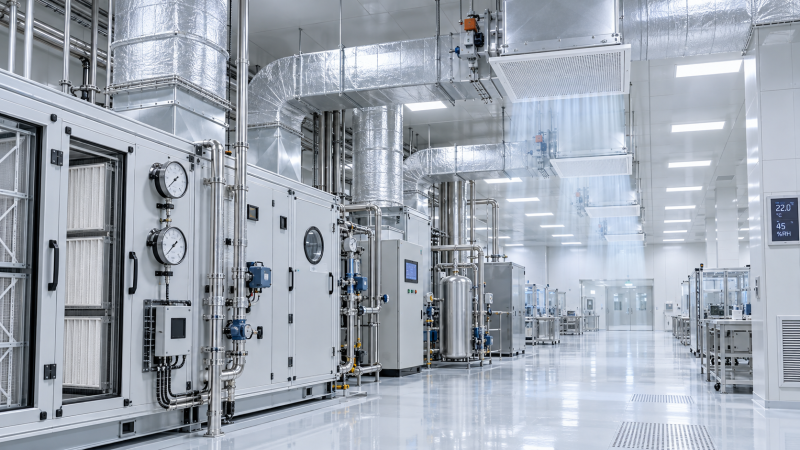
After commissioning, cleanroom operating costs are usually driven by the effort required to keep air moving, clean, dry or humidified, stable in temperature, and demonstrably within the required environmental limits. The installed system may look complete at handover, yet its long-term cost profile is set by operating hours, contamination load, pressure losses, process heat, outdoor weather, production schedules, and the discipline of maintenance.
The largest budget line is often energy, but a lower electricity bill is not automatically a lower total cost. Reducing airflow, loosening temperature bands, or delaying filter replacement can save utility expense while increasing particle excursions, process variability, equipment fouling, or lost production time. A useful evaluation separates unavoidable environmental demand from waste created by poor control, excessive pressure drop, air leakage, simultaneous heating and cooling, or maintenance performed too late.
Air movement sets the recurring energy baseline
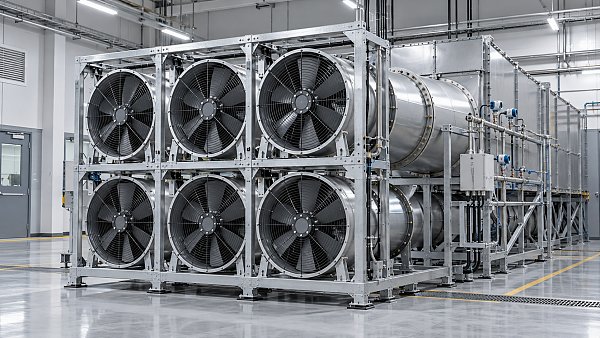
Fan energy is closely tied to the amount of air circulated through the room and the resistance imposed by filters, coils, dampers, ductwork, grilles, and return paths. Fan filter units, air-handling units, recirculation fans, and exhaust fans may run continuously even when production activity changes. In high-air-change spaces, this creates a substantial and persistent electrical load.
Pressure drop deserves more attention than the filter purchase price alone. A filter that remains in service beyond its useful pressure-drop range forces fans to work harder. Conversely, replacing a filter solely because a calendar interval has passed can discard usable media and create unnecessary labor, waste-handling, and material expense. The practical trigger is the relationship between measured differential pressure, required airflow, particle performance, and fan capacity, rather than time alone.
Airflow reductions must be assessed against room recovery, airflow direction, pressure cascades, and contamination generation. A modest setback during inactive periods can be effective where the process, room classification, and restart recovery requirements allow it. The same reduction can be unsuitable where equipment emits particles continuously, materials remain exposed, or adjacent spaces rely on a stable pressure relationship.
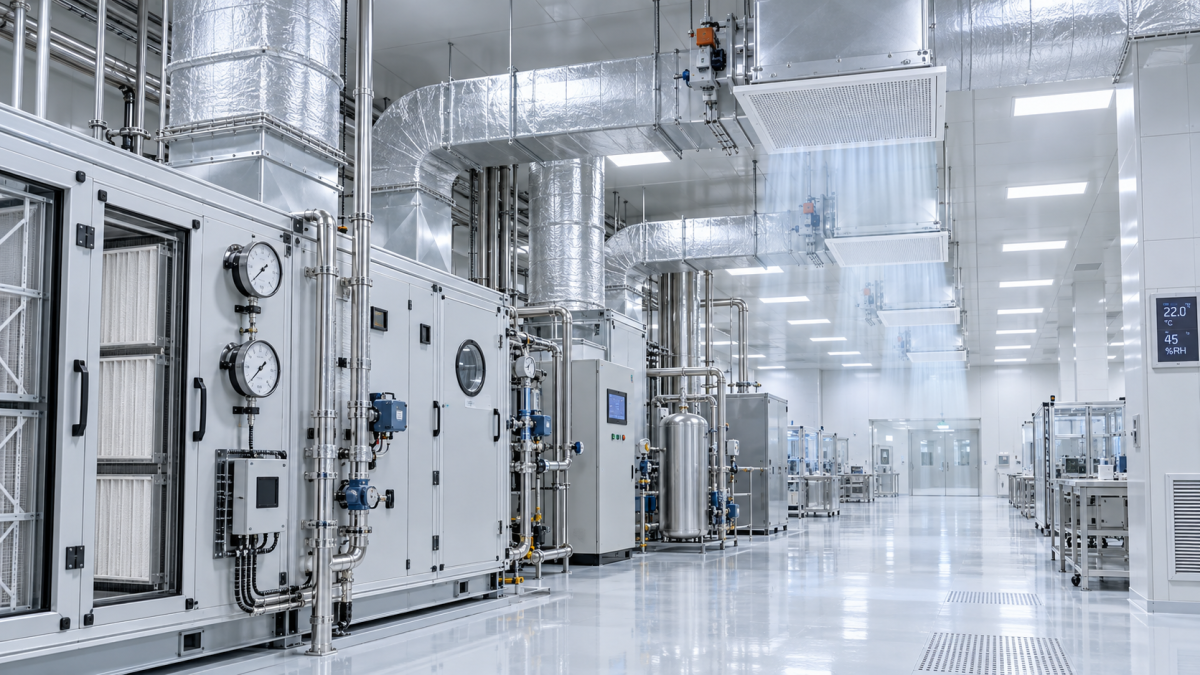
Fan control also changes the cost equation. Systems that use fixed-speed fans and throttling dampers often consume energy to create resistance deliberately. Variable-speed control can reduce waste when airflow demand genuinely varies, but it must be commissioned around actual room pressure, terminal velocity, filter loading, and exhaust balance. A speed reduction that causes doors to become difficult to open, reverses a pressure relationship, or weakens unidirectional flow is not an efficiency measure.
Conditioning outside air can outweigh recirculation savings
Recirculated cleanroom air still needs filtration and sensible cooling, but outdoor air introduces a separate load: heat, moisture, particles, gaseous contaminants, and sometimes corrosive compounds. The quantity of make-up air is shaped by exhaust demand, pressurization targets, infiltration, door traffic, and process equipment connections. Every unit of air exhausted must ultimately be replaced and conditioned.
Humidity control is often costlier and less forgiving than room temperature control. Removing moisture requires cooling air below its dew point and frequently reheating it before supply. Very low-dew-point operations can add desiccant regeneration energy, purge air requirements, and extra cooling demand. The operating cost depends on the latent load entering the system, not simply on the room humidity setpoint. A small leak in a humid climate, a frequently opened loading door, or excessive make-up air can produce a disproportionate increase in dehumidification energy.
Temperature specifications should be read with the same care. A narrow control band requires more frequent equipment response and can expose weaknesses in sensor placement, control tuning, chilled-water stability, and heat-load forecasting. Process tools, lighting, occupants, and adjacent rooms all add heat. When a system simultaneously cools and reheats because sensors disagree or sequences conflict, utility consumption rises without improving the room condition.
Filtration is a lifecycle expense, not a consumable line item
Pre-filters, fine filters, and terminal HEPA or ULPA filters serve different economic purposes. Upstream filtration protects coils, fans, ducts, and final filters from premature loading. Choosing a low-cost pre-filter with weak dust-holding performance can shift cost downstream through more frequent terminal-filter changes, increased cleaning, and higher system resistance.
Final-filter replacement is particularly expensive when access requires shutdown planning, ceiling work, containment, scanning, retesting, and room recovery. The material cost may be modest compared with the labor and production disruption around the task. Filter selection should therefore consider expected aerosol loading, chemical compatibility, gasket integrity, frame rigidity, installation access, and the available pressure reserve of the fan system.
Particle counts alone do not diagnose filter condition. A room may remain within particle limits while fan energy rises because filters are loading gradually. The opposite pattern is also possible: particle excursions with normal differential pressure can point to bypass leakage, damaged seals, poor installation, disrupted airflow, or a contamination source inside the room. Treating every particle event as evidence that a filter is “full” can lead to unnecessary replacement without fixing the actual cause.
Maintenance cost is shaped by access and operating discipline
Cleanrooms contain components that require routine attention: fan bearings, belts where fitted, motors, dampers, valves, condensate drains, cooling coils, humidifiers, sensors, control panels, and exhaust treatment equipment. Deferred maintenance often appears as a small short-term saving before it returns as unstable room conditions, higher energy use, emergency labor, or contamination-related downtime.
Coil cleanliness is a familiar example. A fouled cooling coil restricts airflow and reduces heat transfer, which can raise fan power and impair temperature or humidity control. Yet aggressive cleaning methods can damage fins, leave chemical residues, or introduce moisture and debris into sensitive areas. The maintenance method needs to match coil construction, installed location, drainage arrangements, and the room’s contamination-control procedure.
Humidification equipment requires equally careful attention. Mineral carryover, microbial growth, poorly treated feedwater, failed dispersion components, or leaking valves can create deposits and unstable humidity. The resulting cost is not limited to water and power. It can include cleaning, replacement parts, sensor calibration, and time spent restoring a controlled condition after an abnormal event.
Access design affects labor throughout the facility life. A component placed above a congested ceiling or behind process equipment may require protective work zones, special lifting arrangements, and extended room recovery. These recurring costs are often omitted from early comparisons between apparently similar equipment selections.
Monitoring cost must be matched to the control risk
Continuous monitoring of differential pressure, temperature, relative humidity, airborne particles, airflow, and critical equipment status adds hardware, calibration, data storage, alarm-management, and maintenance expense. Those costs are justified where an unnoticed deviation can affect product quality, worker safety, or documented environmental performance. They become wasteful when sensors are installed without a defined decision, owner, response path, or calibration plan.
Sensor location matters as much as the sensor specification. A temperature probe near a supply diffuser can report a stable value while the occupied process zone experiences variation. A pressure sensor connected through blocked tubing can show a reassuring but inaccurate room differential. A humidity sensor near a local moisture source can cause the control loop to overreact. Repeated alarms often indicate poor placement, unsuitable alarm delays, or a control sequence that does not reflect actual operating states.
Data should distinguish between a transient disturbance and a persistent trend. Door opening, material transfers, and tool maintenance can produce short-lived changes that resolve through normal recovery. A gradual increase in fan speed at a fixed airflow target, repeated valve hunting, or a widening gap between supply and return conditions signals an emerging cost issue before a formal alarm threshold is reached.
Compliance and verification create planned and unplanned expense
Environmental performance must be demonstrated after changes that could affect airflow, filtration integrity, pressure relationships, or room classification. Costs can include test instruments, specialized labor, documentation, access preparation, temporary containment, and production scheduling. A change as small as replacing a terminal filter, adjusting an airflow setpoint, relocating a process tool, or modifying exhaust capacity may require verification under the facility’s quality procedures.
The expensive events are often not the planned tests. They are the investigations triggered by ambiguous records, incomplete maintenance history, unexplained particle events, or a room that cannot return to specification after an intervention. Clear baselines established at commissioning make later troubleshooting faster: design airflow, initial pressure drops, control setpoints, fan speeds, room differentials, and recovery behavior should be retained in a form that can be compared with current conditions.
Process changes alter the operating budget
A cleanroom is rarely static after handover. New equipment may add heat, exhaust demand, vibration, chemical vapors, or localized particle generation. Production shifts can extend operating hours. Changes in garments, packaging, cleaning agents, and material staging can alter contamination load and door traffic. These adjustments may appear operational rather than mechanical, yet they can change filtration life, outdoor-air demand, room recovery time, and utility consumption.
Exhaust changes need special scrutiny. Adding a local exhaust connection without confirming make-up air capacity can pull a room negative, increase infiltration, and destabilize adjacent spaces. Restricting exhaust to reduce energy can affect capture performance or increase vapor concentration near a process. The relevant cost model must include the air-side balance, process safety requirements, and the conditioning load imposed by replacement air.
Cleaning practices also interact with operating cost. Excess liquid cleaning can raise local humidity and prolong recovery. Materials that shed lint or leave residues can increase particle counts and shorten filter life. A more aggressive cleaning schedule is not automatically a cleaner operating condition if the chosen materials or methods introduce contaminants that the HVAC system must then remove.
Reading total cost without distorting the decision
A credible operating-cost review separates fixed loads from controllable loads. Continuous baseline loads include essential recirculation, minimum outdoor air, critical exhaust, standby process heat, and required monitoring. Controllable loads include avoidable pressure drop, excessive airflow during inactive periods, uncontrolled infiltration, poor control tuning, premature filter replacement, leaking valves, and maintenance performed only after failure.
Utility invoices alone cannot reveal which subsystem is responsible. Trend data from fan speed, static pressure, chilled-water valve position, reheat demand, supply and return temperature, humidity, and exhaust airflow provides the operating context. A rise in electrical consumption alongside higher fan speed and static pressure points toward loading or airflow restriction. A rise associated with simultaneous cooling and reheat points toward controls or sequence problems. The remedies differ, and so do their lifecycle consequences.
The most durable savings come from preserving the commissioned environmental intent while removing unnecessary work from the system. Stable airflow paths, properly maintained filter stages, controlled outdoor-air volume, accurate sensing, and disciplined verification reduce avoidable energy and maintenance expenditure without turning cleanliness performance into a budget variable.
Got questions about the latest insights discussed here, or seeking customized strategic advice for your business? Drop us a line below, and let the think-tank experts at CECS help you out.
We respect your privacy. Your information is strictly confidential.
Recommended News
 Nov 28, 2026Choosing a Clean Air Supplier for Semiconductor Fabs: What to CheckChoosing a semiconductor clean air supplier? Compare ISO 14644 testing, airflow, lifecycle costs, and service support to make a confident sourcing decision.
 Nov 25, 2026Technical Column Examines AHU Startup Sequence Failure and System ShutdownAHU startup sequence failure can trigger system shutdown. Explore control interactions, hospital cases and practical steps to reduce operational risk.
 Nov 22, 2026Precise Cleanroom Temperature Control: Managing Heat Loads and StabilityDiscover how precise cleanroom temperature control manages heat loads, airflow and humidity to improve stability and process reliability.
 Nov 21, 2026Air Handling for Electronics Manufacturing: Controlling Particles and HumidityIndustrial air handling for electronics manufacturing: discover how integrated filtration, airflow, and humidity control help protect sensitive processes.
 Nov 16, 2026Applied Materials Warns Cleanroom Constraints Could Limit 2027 Equipment GrowthApplied Materials warns cleanroom constraints could limit 2027 semiconductor equipment growth. Explore the supply chain risks and what buyers should check.
 Nov 15, 2026Cleanroom Thermal Management: How to Maintain Tight Temperature TolerancesMaster cleanroom thermal management for tight tolerance control. Explore practical strategies for airflow, sensors, cooling, and commissioning.
 Nov 13, 2026Choosing Cleanroom Equipment for Pharmaceutical Plants: Key Selection CriteriaChoose cleanroom equipment for pharmaceutical plants with confidence. Explore airflow, filtration, GMP considerations, qualification, and lifecycle costs.
 Nov 10, 2026Choosing a Stainless Steel Cleanroom AHU: Materials and Hygiene CriteriaChoosing cleanroom air conditioning units stainless steel? Compare 304 and 316L, hygiene, drainage, and filter seals to make a confident, evidence-based choice.
 Oct 31, 2026Q-PAC Lab First to Earn AMCA 270 Fan Array Testing AccreditationAMCA 270 fan array testing is now available at Q-PAC's accredited Florida lab. Explore its 2,000–70,000 CFM range and what it means for HVAC project teams.
 Oct 27, 2026Clean Air for Semiconductor Fabs in Southeast Asia: Humidity and Particle ControlSemiconductor clean air Southeast Asia guide: discover how integrated humidity, particle, and exhaust control can protect wafers and improve fab reliability.
 Oct 18, 2026Cleanroom Environmental Control Automation: AHU–FFU Integration for Stable PressureExplore cleanroom environmental control automation with AHU–FFU integration to stabilize pressure, reduce control conflicts, and optimize energy use. Discover practical design and testing tips.
 Oct 10, 2026Which Environmental Control System Alarms Require Immediate Action?What environmental control system alarms require immediate action? Identify critical gas, ventilation, fire, pressure, and climate alarms to protect people, processes, and compliance.
 Oct 15, 2026Which costs drive cleanroom operating costs after commissioning?Cleanroom operating costs after commissioning are driven by airflow, humidity control, filtration, maintenance, and compliance. Discover practical ways to reduce waste while protecting performance.
 Oct 03, 2026How to Specify Precision Air Conditioning for Electronics Plants with Tight Temperature ControlPrecision air conditioning for electronics plants: learn how to specify stable temperature, humidity, airflow, and resilient controls for critical production zones.
 Sep 29, 2026Electronics Cleanroom System Cost: CAPEX, Energy, and Lifecycle Budget FactorsElectronics cleanroom systems cost explained: compare CAPEX, energy use, maintenance, and lifecycle factors to build a smarter, finance-ready budget.
 Sep 26, 2026Semiconductor Manufacturing HVAC: How to Maintain Fab Temperature StabilitySemiconductor manufacturing HVAC temperature stability: practical strategies for precise fab thermal control, airflow balance, humidity coordination, and resilient operations.
 Sep 14, 2026Cleanroom Design Criteria: Airflow, Pressure, Filtration, and ISO ComplianceCleanroom design criteria explained: optimize airflow, pressure cascades, filtration, energy efficiency, and ISO 14644 compliance for reliable, contamination-controlled production.
 Sep 15, 2026Air Handling Units vs. Dedicated Outdoor Air Systems: When to Choose AHUs for Hospital HVAC DesignAir handling units deliver unified, traceable control for hospital HVAC—essential for pressure-critical, humidity-sensitive, and regulatory-compliant clinical spaces.
 Aug 18, 2026How to Evaluate a High-Tech HVAC Manufacturer for Cleanroom and Precision FacilitiesHigh-tech HVAC manufacturer evaluation guide for cleanrooms and precision facilities. Learn how to assess control stability, compliance, serviceability, and long-term operational risk.
 Aug 13, 2026How to Select VAV Airflow Control Systems for Labs and Cleanroom HVAC ProjectsVAV airflow control systems are critical for labs and cleanroom HVAC projects. Discover how to choose the right system for stability, compliance, and energy savings.
 Jul 21, 2026How to Evaluate Cleanroom Equipment Suppliers in the Middle East for New ProjectsCleanroom equipment Middle East supplier selection starts with technical fit, compliance, service, and lifecycle cost. Discover how to evaluate vendors and reduce project risk.
 Jul 19, 2026How to Estimate HVAC Cost for Electronics Manufacturing Cleanrooms and Production AreasElectronics manufacturing HVAC cost explained: learn how cleanroom class, humidity control, filtration, exhaust, and energy recovery shape realistic budgets and smarter project decisions.
 Jul 14, 2026Electronics Cleanroom Systems in Southeast Asia: How to Choose AHU, FFU, and HEPA LevelsElectronics cleanroom systems Southeast Asia: learn how to choose AHU, FFU, and HEPA levels for better yield, humidity control, energy efficiency, and long-term ROI.
 Jul 13, 2026Cleanroom Design Layout Basics: Zoning, Material Flow, and Contamination ControlCleanroom design layout basics explained: learn zoning, material and personnel flow, and contamination control strategies that reduce risk, improve compliance, and support efficient project planning.