Search News
Industry Portal
Hot Articles
- How Factories Can Select Air Quality Controls for Dust, Fumes, and VOCsIndustrial air quality control for factories: learn how to select effective solutions for dust, fumes, and VOCs while improving safety, compliance, energy efficiency, and uptime.
- How to Size Industrial Gas Scrubbing Units for Acid Fumes and Variable AirflowsIndustrial gas scrubbing units: learn how to size acid-fume scrubbers for variable airflows, peak loads, chemical demand, pressure drop, and reliable compliance.
- How to Evaluate Industrial Air Quality Control Systems for Dust, Fumes, and VOCsIndustrial air quality control systems: learn how to evaluate dust, fumes, and VOC solutions by capture efficiency, compliance, maintenance, and lifecycle cost.
Popular Tags
What dust-free manufacturing really requires today
author
Time
Click Count
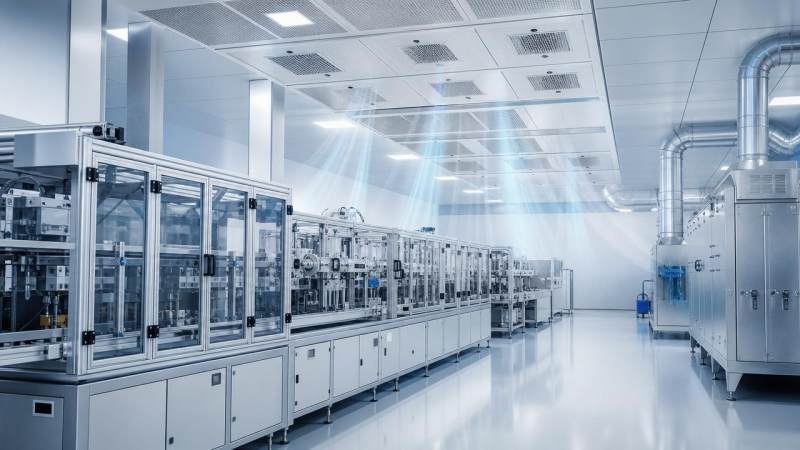
What does dust-free manufacturing really demand today? It is no longer just a filtration question.
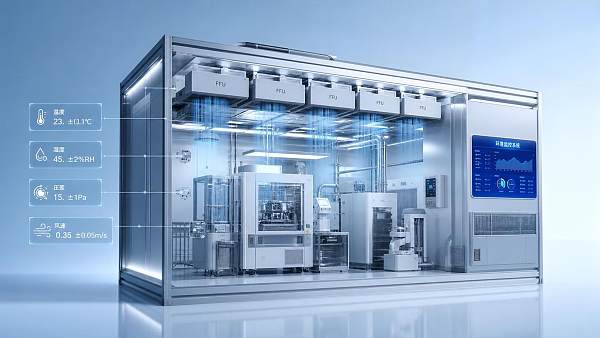
Modern dust-free manufacturing depends on coordinated control of particles, airflow, pressure, temperature, humidity, gas emissions, and energy consumption.
When one variable drifts, yield, compliance, equipment stability, and operating cost can all suffer at once.
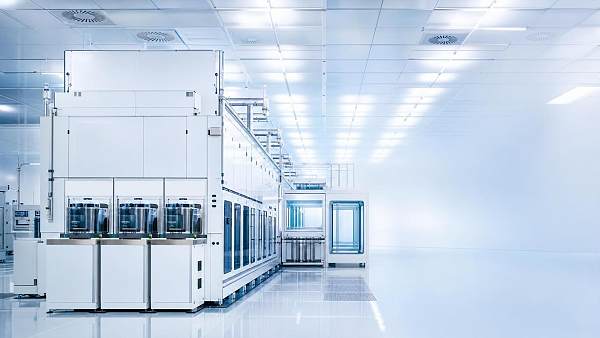
In semiconductor, battery, precision coating, healthcare, food, and advanced assembly environments, clean conditions must support process reliability, not only appearance.
This guide explains what dust-free manufacturing requires today, how systems work together, and what to examine before deployment or upgrades.
What does dust-free manufacturing actually mean today?
Dust-free manufacturing means maintaining an engineered environment where airborne contamination stays below process-specific limits.
That includes visible dust, submicron particles, fibers, oil mist, moisture, corrosive gases, and unstable airflow patterns.
The term often sounds absolute, but practical dust-free manufacturing is based on measurable cleanliness classes and operating tolerances.
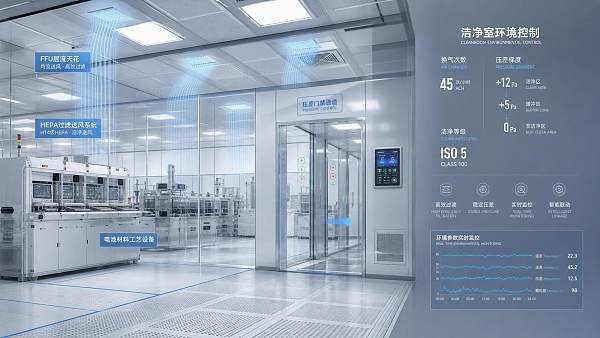
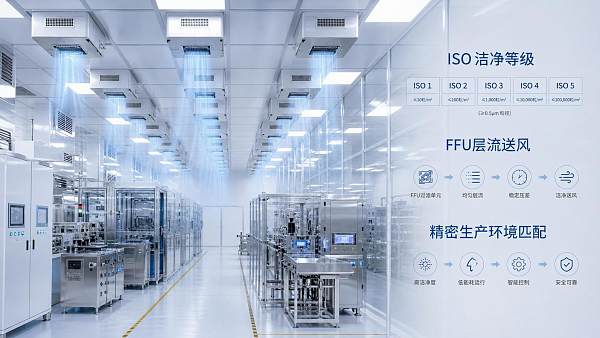
ISO 14644 remains central for cleanroom classification, testing, monitoring, and verification in many high-spec facilities.
Yet classification alone is not enough. A compliant room can still fail process needs if humidity spikes or turbulence appears above critical tools.
Today, dust-free manufacturing must link environmental performance directly to yield protection, product consistency, and emissions control.
Key elements behind modern clean control
- Particle filtration down to process-relevant micron levels
- Stable laminar or controlled mixed airflow
- Pressure cascades between adjacent zones
- Tight temperature and humidity control
- VOC, acid gas, or dust exhaust treatment
- Energy-efficient operation with reliable monitoring
Which systems are essential for effective dust-free manufacturing?
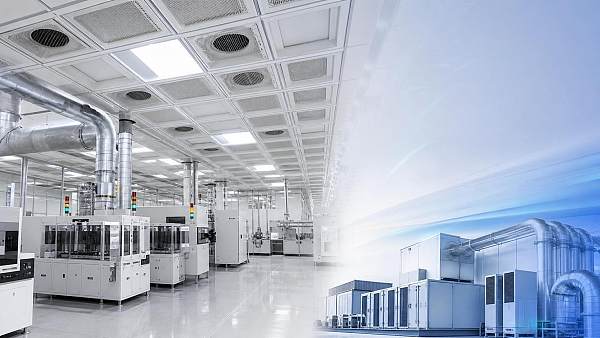
Effective dust-free manufacturing relies on several systems working as one controlled ecosystem.
If one component is undersized or poorly integrated, the whole environment becomes unstable.
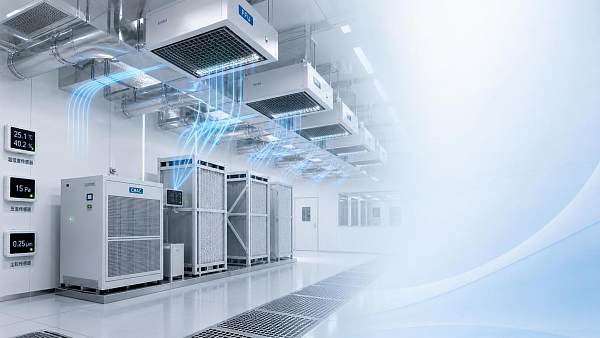
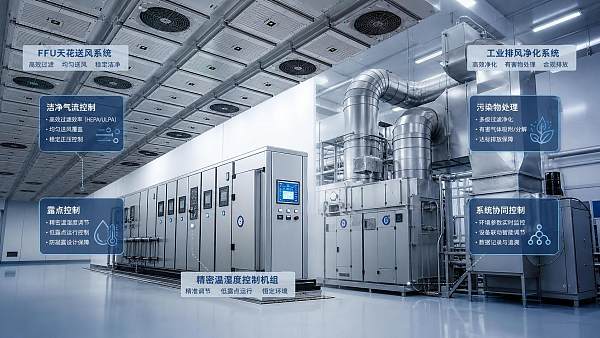
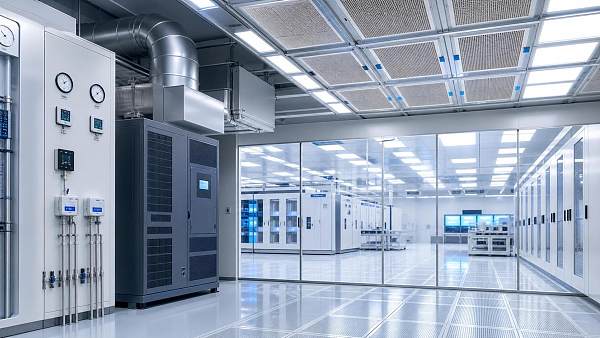
1. Precision CRAC and humidity control
Temperature drift changes material behavior, equipment accuracy, and even electrostatic risk.
Humidity can be even more critical. In battery and lithography spaces, dew point control may need extreme suppression.
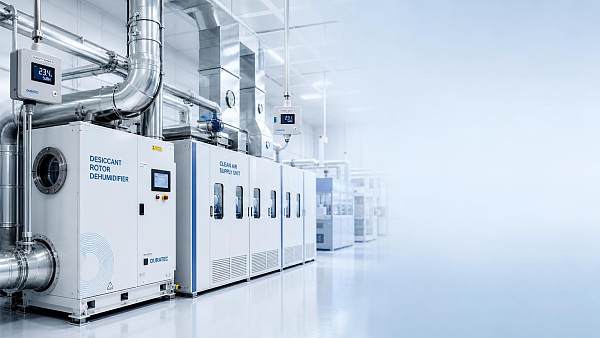
Advanced CRAC systems with desiccant wheels support dust-free manufacturing where trace moisture can trigger failure or chemical instability.
2. FFU arrays and high-efficiency filtration
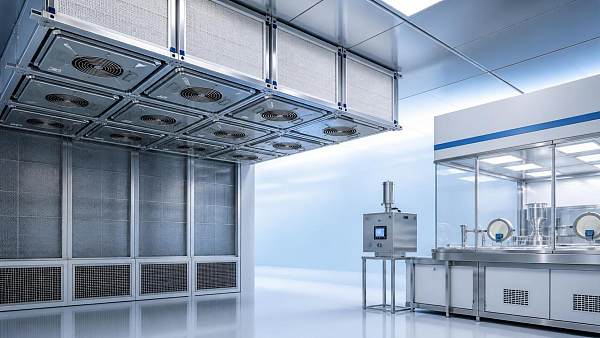
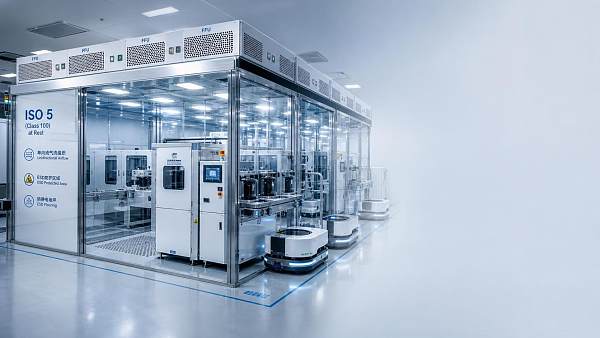
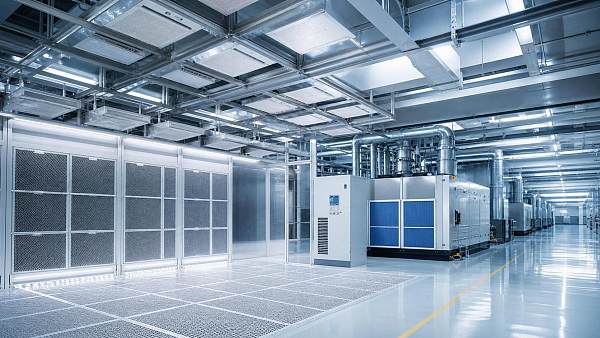
Cleanroom Fan Filter Units create the ceiling-based filtration backbone of many high-spec sites.
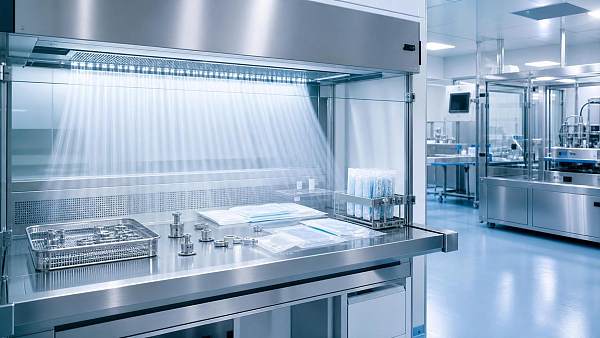
Uniform vertical airflow matters as much as filter efficiency. Uneven velocity can trap particles over process zones.
In dust-free manufacturing, HEPA or ULPA selection should match both cleanliness targets and pressure-drop economics.
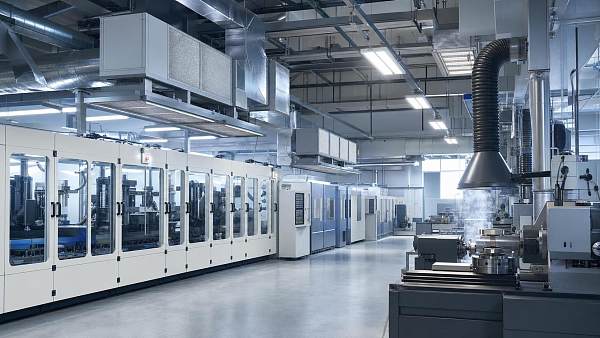
3. Industrial dust collection and gas scrubbing
Some facilities generate contaminants faster than room filtration can manage.
Local capture, cyclone separation, cartridge collection, plasma catalysis, and wet scrubbing are often required.
Dust-free manufacturing fails quickly when source emissions are ignored and only room recirculation is emphasized.
4. Ventilation and pressure zoning
Workshops need directional airflow that moves contaminants away from critical operations.
Pressure cascades prevent dirty air migration between corridors, gowning areas, clean zones, and exhaust-intensive rooms.
Without zoning discipline, dust-free manufacturing becomes vulnerable at doors, pass-throughs, and maintenance access points.
5. Energy recovery and lifecycle optimization
Clean air is expensive to condition, especially with large outdoor air volumes.
ERV systems help recover sensible and latent energy while reducing central HVAC load.
For dust-free manufacturing, energy efficiency is no longer separate from environmental control. It shapes long-term viability.
How do different industries define dust-free manufacturing requirements?
Dust-free manufacturing is not a single template. The target condition depends on process sensitivity and contamination consequences.
Semiconductors and microelectronics
These spaces require aggressive particle control, airflow uniformity, and strict molecular contamination discipline.
Very small particles can destroy yield, distort lithography, or damage wafer surfaces.
Lithium battery and coating lines
Low humidity is often decisive. Moisture can react with materials and compromise safety and product quality.
Here, dust-free manufacturing includes dew point control as a first-order requirement.
Pharma, healthcare, and biotech
Bioburden, pressure segregation, and validation routines become central.
Particle metrics remain important, but hygienic design and cleaning compatibility also drive system choice.
Food, precision assembly, and specialty materials
Requirements vary widely. Some lines need basic dust exclusion, while others need high-purity enclosed micro-environments.
The correct dust-free manufacturing strategy should reflect process loss risk, not generic branding language.
How can performance be judged beyond filter ratings?
Many evaluations stop at HEPA grade or nominal airflow, but real dust-free manufacturing needs broader performance evidence.
Look at these practical benchmarks
- ISO cleanliness class under actual operating conditions
- Air velocity consistency across critical work zones
- Recovery time after door opening or disturbance
- Differential pressure stability between rooms
- Temperature and relative humidity deviation range
- Dew point capability where moisture-sensitive processes exist
- Energy use per treated air volume
- Filter replacement cycle and maintenance accessibility
A robust dust-free manufacturing setup should show stable performance during shifts, cleaning, production changes, and seasonal weather variation.
That is why monitoring and commissioning matter as much as equipment nameplates.
What mistakes weaken dust-free manufacturing projects?
Several recurring errors reduce effectiveness, even when expensive equipment has been installed.
Common misconceptions and risks
- Treating filtration as the only cleanroom variable
- Ignoring source capture for fumes, powders, or VOCs
- Choosing cleanliness classes without linking them to process needs
- Underspecifying humidity and dew point targets
- Designing airflow without checking tool layout and operator movement
- Forgetting maintenance access and validation planning
- Optimizing capital cost while ignoring energy burden
Dust-free manufacturing also fails when compliance is handled late instead of being built into design documents and test plans.
Standards, documentation, and performance verification should be defined before construction or retrofit begins.
How should implementation, cost, and upgrades be planned?
The best dust-free manufacturing strategy balances cleanliness, uptime, flexibility, and operating efficiency.
New builds allow full zoning and airflow planning, but retrofits often need phased solutions.
Useful planning steps
- Map contamination sources and critical process points.
- Define cleanliness, humidity, temperature, and pressure targets.
- Select source capture, room filtration, and ventilation as one package.
- Estimate lifecycle energy, not only purchase cost.
- Plan commissioning, monitoring, and future capacity expansion.
High-performance dust-free manufacturing usually costs more upfront when control precision is extreme.
However, lower scrap, fewer shutdowns, better compliance, and reduced HVAC waste can justify the investment over time.
Quick FAQ comparison table
Dust-free manufacturing today requires more than a cleanroom label or a premium filter specification.
It requires engineered coordination between micro-dust isolation, airflow discipline, humidity precision, emissions treatment, and energy-conscious operation.
The strongest results come from matching environmental control tightly to real process risk and compliance demands.
A practical next step is to review contamination sources, control targets, and monitoring gaps before any system selection begins.
That approach turns dust-free manufacturing from a marketing phrase into a measurable production advantage.
Recommended News
 Aug 25, 2026How to Select Cleanroom Particle Control Equipment for ISO Class and Process RiskCleanroom particle control equipment selection starts with process risk, ISO class, and airflow design. Learn how to compare FFUs, filters, and monitoring for reliable performance.
 Aug 23, 2026How Laminar Airflow Supports Compliance and Contamination Control in Medical Device ManufacturingLaminar airflow for medical devices helps reduce contamination risk, support cleanroom compliance, and improve audit readiness—see how it protects product quality and manufacturing control.
 Aug 21, 2026How to Achieve Stable RH Precision Humidity Control in Cleanroom Production?Stable RH precision humidity control starts with process-based design. Learn how airflow, sensors, dehumidification, and recovery logic keep cleanroom production consistent and reliable.
 Aug 19, 2026What Drives Cleanroom Compliance Cost in Pharma and Semiconductor Projects?Cleanroom compliance cost in pharma and semiconductor projects depends on ISO class, airflow, humidity control, validation, and energy use. Learn what drives cost and how to avoid costly overdesign.
 Aug 11, 2026How to Select Precision Humidity Control for Cleanrooms and Micro-EnvironmentsPrecision humidity control for cleanrooms starts with process needs. Learn how to compare dew point targets, airflow, controls, and energy tradeoffs for reliable, high-yield micro-environments.
 Aug 05, 2026How Cleanroom Environmental Control Automation Improves Compliance and StabilityCleanroom environmental control automation improves compliance, stability, and audit readiness through faster response, traceable control logic, and consistent environmental performance.
 Aug 04, 2026How Smart Cleanroom Thermal Control Improves Stability in FFU-Based Micro-EnvironmentsSmart cleanroom thermal control improves FFU-based micro-environment stability by aligning temperature, humidity, pressure, and airflow—learn what to evaluate before performance drifts.
 Aug 03, 2026Semiconductor Cleanroom Standards Explained: ISO Classes, Air Changes, and ESD ControlsCleanroom standards for semiconductor industry explained: understand ISO classes, air changes, and ESD controls to improve yield, reduce contamination risk, and choose smarter fab environments.
 Jul 30, 2026How to Choose Environmental Control Solutions for High-Tech Manufacturing FacilitiesHigh-tech manufacturing environment solutions guide: learn how to evaluate cleanroom airflow, dew point control, exhaust treatment, and compliance to protect yield and cut lifecycle risk.
 Jul 29, 2026How to Design Ventilation for Precision Manufacturing to Control Particles and HeatPrecision manufacturing ventilation design guide: learn how to control particles, heat, airflow, filtration, and pressure for cleaner production, higher yield, and more reliable operations.
 Jul 26, 2026ISO 5 Semiconductor Cleanroom Solutions: Key Design Criteria for Process StabilityISO 5 semiconductor cleanroom solutions focus on process stability, airflow uniformity, pressure control, and thermal consistency to protect yield and improve fab performance.
 Jul 24, 2026Cleanroom Standards Compliance: Key Requirements and Audit Readiness ChecklistCleanroom standards compliance starts with real control, not paperwork. Explore key ISO requirements, common audit gaps, and a practical checklist to improve readiness.
 Jul 20, 2026How to Evaluate a Semiconductor Cleanroom Solutions Supplier for Fab ProjectsSemiconductor cleanroom solutions supplier selection can make or break fab performance. Learn how to compare engineering depth, compliance, delivery, and lifecycle value.
 Jul 15, 2026Dust-Free Manufacturing: Key Process Controls for Cleaner Production LinesDust-free manufacturing starts with tighter control of airflow, humidity, filtration, and gas capture. Discover how cleaner production lines improve yield, safety, compliance, and energy performance.
 Jul 13, 2026How Semiconductor Environmental Control AMC Reduction Prevents Yield LossSemiconductor environmental control AMC reduction is essential to prevent yield loss. Learn how airflow, humidity, filtration, and gas treatment protect fabs and improve process stability.
 Jul 12, 2026How to Choose Semiconductor Cleanroom Solutions for EUV Lithography LinesSemiconductor cleanroom solutions for EUV require more than ISO class compliance. Learn how to compare airflow, AMC, thermal stability, vibration, and lifecycle cost for better yield.
 Jul 11, 2026Cleanroom Design Criteria Explained: Air Changes, Pressure Cascade, and ISO ClassCleanroom design criteria explained: learn how air changes, pressure cascade, and ISO Class work together to improve contamination control, compliance, and process stability.
 Jul 09, 2026Semiconductor Facility Ventilation Standards: Pressure Cascade, Air Changes, and ComplianceSemiconductor facility ventilation explained: pressure cascade, air changes, and compliance essentials to protect yield, control contamination, and reduce hidden operational risk.
 Jul 09, 2026Clean Environment Control Solutions for Dust, Humidity, and ESD in Sensitive ProductionClean environment control solutions for dust, humidity, and ESD help sensitive production improve yield, ensure compliance, cut energy waste, and reduce costly rework.
 Jul 08, 2026Cleanroom Standards ISO Class Explained: How to Match Class Levels to ProductionCleanroom standards ISO class explained clearly: learn how to match class levels to production needs, reduce contamination risk, control costs, and choose smarter cleanroom strategies.
 Jul 08, 2026How Electronics Cleanroom Air Showers Reduce Particle Transfer at Entry PointsElectronics cleanroom air showers reduce particle transfer at entry points, protect sensitive processes, and support better yield, cleaner airflow, and more reliable contamination control.
![]() Jul 07, 2026Cleanroom Certification USA: ISO Classes, Testing Steps, and Common Compliance GapsCleanroom certification USA explained: compare ISO classes, understand key testing steps, and spot common compliance gaps before they trigger audit issues, downtime, or product risk.
Jul 07, 2026Cleanroom Certification USA: ISO Classes, Testing Steps, and Common Compliance GapsCleanroom certification USA explained: compare ISO classes, understand key testing steps, and spot common compliance gaps before they trigger audit issues, downtime, or product risk. Jul 06, 2026What Is Semiconductor Clean Air and Why Does It Matter in Contamination Control?Semiconductor clean air is vital to contamination control, protecting yield, tool stability, and process consistency. Learn why it matters in modern fabs.
 Jul 05, 2026Cleanroom Airflow Control Systems Explained: How to Balance Pressure, Air Changes, and StabilityCleanroom airflow control systems explained: learn how to balance pressure, air changes, and stability to improve contamination control, cut energy waste, and protect production yield.