Search News
Industry Portal
Hot Articles
- When Does Cyclone Separation for Dust Collection Reduce Baghouse Filter Loading?Cyclone separation for dust collection can reduce baghouse filter loading by removing coarse, abrasive dust. Discover key sizing, flow, and discharge factors.
- What Determines Low Dew Point Dehumidification System Price for Dry Rooms?Low dew point dehumidification systems price depends on dew point targets, moisture loads, regeneration energy, controls, and installation scope. Compare costs confidently.
- Electronics Cleanroom System Cost: CAPEX, Energy, and Lifecycle Budget FactorsElectronics cleanroom systems cost explained: compare CAPEX, energy use, maintenance, and lifecycle factors to build a smarter, finance-ready budget.
Popular Tags
MIIT Launches 2026 Industrial Energy Efficiency Inspection
author
Time
Click Count
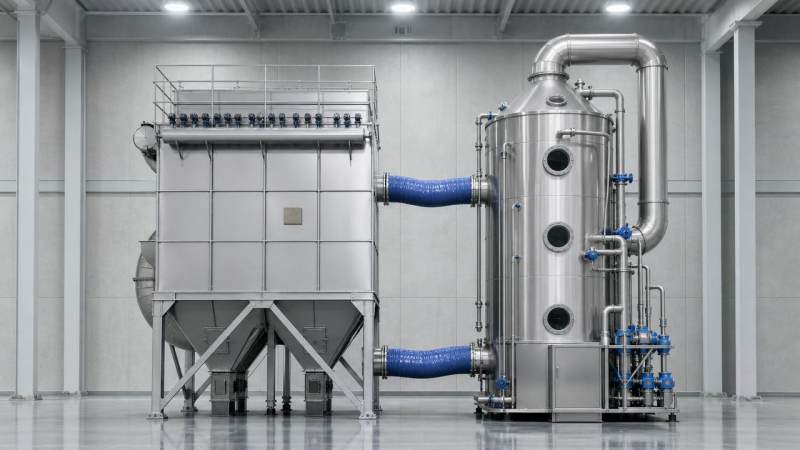
On May 14, 2026, the Ministry of Industry and Information Technology (MIIT) initiated the 2026 National Industrial Energy Efficiency Inspection program, explicitly naming wet scrubbers and pulse-jet dust collectors as priority equipment categories. This marks the first time these two air pollution control technologies have been formally included in MIIT’s mandatory energy efficiency supervision framework — a move driven by tightening global decarbonization demands and rising scrutiny on embodied energy performance in exported industrial equipment.
Event Overview
On May 14, 2026, MIIT issued an official notice mandating that manufacturers and exporters of wet scrubbers and pulse-jet dust collectors complete energy efficiency grade labeling registration and upload third-party test reports to the national Energy Efficiency Information Management Platform by the end of Q3 2026. The inspection scope covers all domestically produced units intended for domestic use or export, regardless of OEM arrangement or final destination.
Industries Affected
Direct Trade Enterprises: Exporters of Chinese-made air pollution control equipment face immediate compliance pressure. Non-compliance may trigger customs delays in key markets — particularly the EU (under Ecodesign Regulation Annex IV review pathways) and the UAE (where DEWA now requires verified kW/m³·h data for procurement eligibility). Revenue risk arises not only from shipment holds but also from contractual penalties tied to LEED/EDGE documentation commitments.
Raw Material Procurement Enterprises: Firms sourcing structural steel, filtration media, or high-efficiency blowers for these devices must now align supplier specifications with energy performance traceability requirements. For example, blower vendors are increasingly asked to provide ISO 5801-certified fan curves alongside motor efficiency class (IE4/IE5) declarations — data previously optional but now essential for downstream label validation.
Manufacturing Enterprises: Equipment integrators and system builders must reconfigure internal quality control workflows: energy efficiency verification is no longer a post-production add-on but a design-phase requirement. This includes recalibrating CFD modeling assumptions (e.g., pressure drop thresholds across filter media), validating fan-motor coupling efficiency under real-world duty cycles, and documenting airflow calibration protocols per GB/T 1236–2017.
Supply Chain Service Enterprises: Third-party testing labs, certification bodies (e.g., CQC, CTI), and technical documentation agencies report surging demand for EN 18891-compliant energy performance testing and bilingual (CN/EN) label drafting support. Lead times for accredited airflow + power consumption testing have extended from 12 to 22 working days — a bottleneck likely to persist through Q3.
Key Focus Areas & Recommended Actions
Verify Labeling Eligibility Against GB 30252–2023
Confirm whether your wet scrubber or pulse-jet unit falls within the rated airflow (≥1,000 m³/h) and static pressure (≥1,200 Pa) thresholds defined in the 2023 national standard. Units below these thresholds are exempt — but misclassification carries audit risk.
Prioritize Third-Party Testing with ISO/IEC 17025 Accreditation
Only test reports issued by laboratories accredited for GB/T 1236 (airflow), GB/T 1032 (motor efficiency), and GB/T 29529 (fan sound power) will be accepted. Reports lacking scope-specific accreditation stamps will be rejected during platform submission.
Update Technical Documentation for International Clients
Prepare dual-language (English + Chinese) Energy Performance Declarations aligned with ISO 50002:2014 structure — including test conditions, uncertainty margins, and comparability notes against EU Lot 31 or US DOE AP-42 benchmarks. This supports faster LEED MR Credit 2 or EDGE Energy Efficiency documentation review.
Editorial Perspective / Industry Observation
Observably, this inspection initiative signals a strategic pivot: MIIT is shifting from voluntary energy labeling (as seen in past HVAC or pump programs) to enforceable, export-linked accountability. Analysis shows the timing correlates closely with the EU’s upcoming revision of the Ecodesign for Air Cleaning Equipment Working Plan (expected Q4 2026), suggesting coordinated regulatory alignment rather than unilateral action. From an industry standpoint, the focus on kW/m³·h — a volumetric specific energy metric — better reflects real-world operational burden than standalone motor efficiency ratings. This makes the policy more technically grounded, though it also raises the bar for SMEs lacking in-house metrology capacity.
Conclusion
This is not merely a compliance checkpoint — it is a foundational step toward embedding verifiable energy intelligence into China’s environmental equipment value chain. For global buyers, it strengthens confidence in performance claims; for domestic producers, it accelerates product differentiation beyond price. The long-term implication is clearer market segmentation: ‘verified-efficiency’ units will command premium pricing and faster green financing access, while non-verified units may face de facto market exclusion in sustainability-driven tenders.
Source Attribution
Official Notice No. MIIT-Energy[2026]17, issued May 14, 2026, published on www.miit.gov.cn. Supporting standards: GB 30252–2023 (Energy Efficiency Limits), GB/T 32045–2015 (Testing Methodology), and MIIT Circular on Energy Labeling Platform Operation (2025 Revision). Continued observation required on: (1) enforcement timelines for non-compliant units post-Q3; (2) potential extension to electrostatic precipitators and thermal oxidizers in 2027.
Recommended News
 Sep 20, 2026How to Select a Gas Scrubbing System for Corrosive Industrial Exhaust StreamsGas scrubbing systems for exhaust: learn how to match corrosive stream chemistry, scrubber design, materials, controls, and compliance needs for reliable performance.
 Sep 16, 2026Selecting Corrosion-Resistant Zero-Emission Gas Treatment for Acidic Exhaust StreamsCorrosion resistant zero-emission gas treatment: discover how to match materials, scrubber design, waste control, and uptime needs for acidic exhaust streams.
 Sep 11, 2026Selecting Industrial Air Scrubbers for European Plants: Airflow, Filters, and ComplianceIndustrial air scrubbers Europe: learn how to match airflow, filtration, gas chemistry, ATEX considerations, and compliance needs for reliable, efficient plant emissions control.
 Sep 03, 2026Industrial Gas Scrubbing Pricing: Cost Drivers for Compliance ProjectsIndustrial gas scrubbing pricing explained: compare compliance cost drivers, installation scope, operating expenses, and supplier quotes for smarter investments.
 Aug 27, 2026How to Size Industrial Gas Scrubbing Units for Acid Fumes and Variable AirflowsIndustrial gas scrubbing units: learn how to size acid-fume scrubbers for variable airflows, peak loads, chemical demand, pressure drop, and reliable compliance.
 Aug 07, 2026How to Choose an Industrial Gas Purification System for Corrosive Emissions?Industrial gas purification system selection starts with chemistry, corrosion resistance, compliance, and lifecycle cost. Learn how to compare solutions for corrosive emissions with confidence.
 Aug 02, 2026How to Select FRP Industrial Gas Scrubbers for Corrosive Exhaust Streams?FRP industrial gas scrubbers selection guide for corrosive exhaust streams: compare resin, scrubber type, pressure drop, and controls to improve compliance, durability, and ROI.
 Jul 28, 2026How to Evaluate a Gas Scrubbing Systems Supplier for Compliance and Long-Term Cost?Gas scrubbing systems supplier selection affects compliance, uptime, and lifetime cost. Learn how to compare process fit, materials, maintenance, and real operating risk before you buy.
 Jul 26, 2026EPA Rule Takes Effect for Imported Wet ScrubbersEPA rule for imported wet scrubbers now ties U.S. market access to 95% VOCs removal and MQTT emissions uploads. Learn the compliance risks, CBP impact, and key actions exporters should take.
 Jul 09, 2026Industrial Exhaust Treatment Cost Breakdown: CAPEX, OPEX, and Key Price DriversIndustrial exhaust treatment cost explained: compare CAPEX, OPEX, and key price drivers to budget smarter, avoid hidden expenses, and choose the right compliant system.
 Jul 08, 2026China Adds Wet Scrubbers to Export ChecksChina adds wet scrubbers to export checks, bringing stricter inspection, test report requirements, and 5–7 extra clearance days. Learn how exporters and buyers can avoid delays.
 Jul 06, 2026EU Tightens Wet Scrubber VOC Rules for 2026EU Tightens Wet Scrubber VOC Rules for 2026: Learn how new EU compliance, CE marking, dynamic load testing, and real-time VOC reporting will impact exporters and buyers.
 Jun 30, 2026REACH Nickel Limits Tighten for Scrubber PartsREACH nickel limits tighten for scrubber parts from 2027. Learn the new 0.05 mg/cm²/week rule, affected RTO/RCO and wet scrubber components, and how exporters can avoid EU customs risk.
 Jun 28, 2026PP Gas Scrubbers vs FRP Scrubbers: Which Is Better for Corrosive Exhaust Applications?PP gas scrubbers vs FRP scrubbers: compare corrosion resistance, temperature limits, maintenance, and lifecycle cost to choose the best solution for corrosive exhaust applications.
 Jun 26, 2026Wet Scrubber Systems vs RTO: Which VOC Control Option Fits Your Process?Wet scrubber systems or RTO? Compare VOC control by moisture, acid gas, energy use, and lifecycle cost to find the right fit for your process.
 Jun 26, 2026ENTECH Vietnam 2026 Opens as Wet Scrubbers Gain BuyersENTECH Vietnam 2026 highlights rising wet scrubbers demand, with 270+ qualified buyer inquiries focused on exhaust gas treatment. See why Vietnam buyers now prioritize control accuracy, corrosion resistance, and fast local service.
 Jun 25, 2026ENTECH Vietnam 2026 Opens as Wet Scrubbers Gain TractionWet scrubbers gain momentum at ENTECH Vietnam 2026 as EPC contractors in Bac Ninh and Hai Phong show sample-testing interest. Explore why fast delivery and local spare-parts support matter.
 Jun 23, 2026EPA Draft Tightens VOCs Margin Proof for ImportsEPA draft tightens VOCs margin proof for imports of Wet Scrubbers and RTO/RCO systems. See how Q2 2027 rules may impact compliance costs, delivery timelines, and export readiness.
 Jun 22, 2026Qingdao Water Conference 2026 Highlights Coastal治理 TechnologiesQingdao Water Conference 2026 highlights coastal governance technologies, from corrosion-resistant Wet Scrubbers to IP68 and ISO 8501-1 Sa2.5-ready solutions—see what buyers and suppliers should watch.
 Jun 21, 2026Industrial Gas Scrubbing for Acid Fumes: Wet Scrubber Selection and Common MistakesIndustrial gas scrubbing for acid fumes: learn how to choose the right wet scrubber, avoid common design mistakes, and improve corrosion control, compliance, and long-term uptime.
 Jun 21, 2026EPA Tightens Wet Scrubber Import RequirementsWet Scrubber import rules are changing fast. Learn how the EPA’s 2026 compliance notice affects banned neutralizers, testing documents, export readiness, and U.S. market access before the Sept. 1 deadline.
 Jun 20, 2026EPA Tightens Import Rules for Wet ScrubbersEPA Tightens Import Rules for Wet Scrubbers: learn how the 2026 EPA update affects VOC control imports, chemical documentation, customs risk, and on-time delivery.
 Jun 19, 2026EPA Tightens Import Rules for Wet ScrubbersEPA tightens import rules for wet scrubbers: from Sept. 1, 2026, U.S. entries need a manufacturer-signed compliance declaration. Learn the risks, deadlines, and steps importers must take now.
 Jun 18, 2026EPA import rule tightens for wet scrubbersEPA import rule tightens for wet scrubbers entering the U.S. from Sept. 1, 2026. Learn key declaration requirements, CBP entry risks, and what importers and manufacturers must prepare now.