Search News
Industry Portal
Hot Articles
- How Factories Can Select Air Quality Controls for Dust, Fumes, and VOCsIndustrial air quality control for factories: learn how to select effective solutions for dust, fumes, and VOCs while improving safety, compliance, energy efficiency, and uptime.
- How to Size Industrial Gas Scrubbing Units for Acid Fumes and Variable AirflowsIndustrial gas scrubbing units: learn how to size acid-fume scrubbers for variable airflows, peak loads, chemical demand, pressure drop, and reliable compliance.
- How to Evaluate Industrial Air Quality Control Systems for Dust, Fumes, and VOCsIndustrial air quality control systems: learn how to evaluate dust, fumes, and VOC solutions by capture efficiency, compliance, maintenance, and lifecycle cost.
Popular Tags
CIBF2026 Closes: Solid-State Battery Scale-Up Drives Cleanroom HVAC Demand
author
Time
Click Count
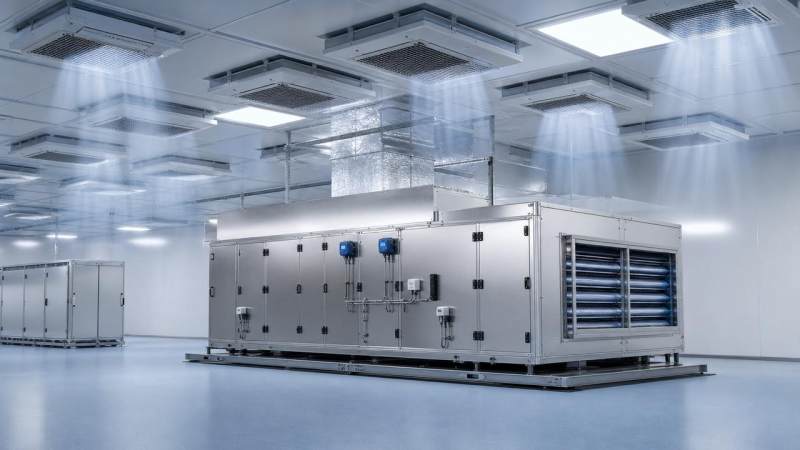
The 18th Shenzhen International Battery Fair (CIBF2026) concluded on May 15, signaling accelerated pilot-scale deployment of solid-state batteries—and concurrently triggering sharp demand for high-specification cleanroom air handling units (AHUs) and laminar flow fan filter units (FFUs). Industries involved in lithium-ion battery manufacturing infrastructure, precision environmental control systems, and洁净room component supply should monitor this development closely, as it reflects a tangible shift in facility requirements tied to next-generation battery production.
Event Overview
The 18th Shenzhen International Battery Fair (CIBF2026) closed on May 15. Publicly reported outcomes include intensified commissioning of solid-state battery pilot lines, with resulting demand for lithium battery coating and assembly facilities meeting Class 100 (ISO 5) or stricter cleanliness standards, ±0.3°C temperature control accuracy, and ±1% RH humidity control precision. Multiple leading battery manufacturers signed procurement intentions on-site for Cleanroom AHUs and Class 100 Laminar FFUs—specifying compatibility with −40°C dew point operation and integrated VOC online monitoring interfaces.
Impact on Specific Industry Segments
Component Manufacturing Enterprises (Cleanroom HVAC & Filtration)
These firms are directly affected due to the explicit technical specifications now required: Class 100 laminar flow performance, ultra-low dew point capability (−40°C), and embedded VOC sensing interfaces. Impact manifests in engineering validation timelines, material selection (e.g., corrosion-resistant heat exchangers), and firmware integration requirements—not just airflow capacity.
Lithium Battery Production Equipment Integrators
Integrators responsible for turnkey cleanroom solutions face revised scope-of-work expectations. Facility design must now embed tighter environmental tolerances across coating, drying, and cell assembly zones—requiring closer coordination with HVAC suppliers early in project planning, rather than treating air systems as commoditized add-ons.
Industrial Automation & Sensor Suppliers
VOC online monitoring is no longer optional but specified as a functional interface requirement. Suppliers offering calibrated, real-time VOC detection modules compatible with standard industrial communication protocols (e.g., Modbus TCP, BACnet/IP) may see increased qualification requests from AHU/FFU OEMs.
Facility Engineering & EPC Contractors
Contractors managing battery gigafactory builds must now treat cleanroom HVAC as a critical path item—not only for certification but for process yield assurance. Delays in AHU/FFU delivery or commissioning could constrain line ramp-up schedules, especially where solid-state battery processes are moisture- and contaminant-sensitive.
What Relevant Enterprises or Practitioners Should Focus On
Track official technical specifications issued by battery OEMs post-CIBF
While procurement intentions were signed at the show, formal RFQs and detailed technical data packages (TDPs) have not yet been publicly released. Current activity signals directionality—not finalized specs. Monitoring OEM engineering bulletins over Q3 2024 is more actionable than reacting to exhibition announcements alone.
Verify compatibility of existing AHU/FFU platforms with −40°C dew point and VOC interface requirements
Many standard cleanroom AHUs operate down to −20°C or −30°C dew point. Achieving −40°C typically demands cascade refrigeration or desiccant hybrid systems—impacting footprint, power draw, and maintenance access. Existing product lines should be audited against this threshold before pursuing bid opportunities.
Distinguish between Class 100 laminar flow claims and verified ISO 14644-3 compliant performance
“Class 100” is often used informally. True laminar flow compliance under dynamic operating conditions (e.g., during equipment loading or door openings) requires full-system testing per ISO 14644-3. Firms quoting based on static lab data risk non-conformance during final acceptance testing.
Prepare cross-functional alignment between mechanical, controls, and process engineering teams
VOC monitoring integration is not solely an instrumentation task—it affects alarm logic, ventilation rate modulation, and interlock behavior with solvent handling systems. Early engagement between HVAC suppliers and battery process engineers helps avoid late-stage rework.
Editorial Observation / Industry Perspective
Observably, CIBF2026 did not announce a new technology—but rather confirmed a shift in infrastructure readiness thresholds driven by solid-state battery process maturity. Analysis shows this is less about immediate volume orders and more about specification hardening: previously aspirational tolerances (e.g., ±0.5°C, Class 1,000) are now being codified into procurement criteria. From an industry perspective, this signals that environmental control is transitioning from a supporting utility to a production-critical subsystem—one whose failure mode directly impacts electrolyte stability and interfacial resistance. Continued attention is warranted because these specifications will likely cascade into Tier 2 supplier qualification requirements and regional building code updates within 12–18 months.

Conclusion
This development underscores how advances in battery electrochemistry are reshaping upstream infrastructure demands—not incrementally, but through step-change requirements in environmental precision. It is best understood not as a short-term sales spike, but as an inflection point in cleanroom system design philosophy for advanced energy storage manufacturing. Stakeholders should treat it as a signal requiring technical reassessment—not just commercial opportunity scanning.
Source Attribution:
Main source: Official CIBF2026 exhibition summary and on-site procurement announcements (Shenzhen Convention & Exhibition Group, May 2024).
Note: Formal contract values, delivery timelines, and OEM-specific technical documentation remain unconfirmed and are subject to ongoing verification.
Recommended News
 Aug 28, 2026How Factories Can Select Air Quality Controls for Dust, Fumes, and VOCsIndustrial air quality control for factories: learn how to select effective solutions for dust, fumes, and VOCs while improving safety, compliance, energy efficiency, and uptime.
 Aug 27, 2026How to Size Industrial Gas Scrubbing Units for Acid Fumes and Variable AirflowsIndustrial gas scrubbing units: learn how to size acid-fume scrubbers for variable airflows, peak loads, chemical demand, pressure drop, and reliable compliance.
 Aug 26, 2026How to Evaluate Industrial Air Quality Control Systems for Dust, Fumes, and VOCsIndustrial air quality control systems: learn how to evaluate dust, fumes, and VOC solutions by capture efficiency, compliance, maintenance, and lifecycle cost.
 Aug 25, 2026How to Select Cleanroom Particle Control Equipment for ISO Class and Process RiskCleanroom particle control equipment selection starts with process risk, ISO class, and airflow design. Learn how to compare FFUs, filters, and monitoring for reliable performance.
 Aug 24, 2026How to Choose a Ducted Heat Recovery Ventilation System for Commercial BuildingsDucted heat recovery ventilation for commercial buildings: learn how to compare efficiency, static pressure, controls, IAQ, and lifecycle cost to choose a smarter, high-performance system.
 Aug 23, 2026How Laminar Airflow Supports Compliance and Contamination Control in Medical Device ManufacturingLaminar airflow for medical devices helps reduce contamination risk, support cleanroom compliance, and improve audit readiness—see how it protects product quality and manufacturing control.
 Aug 22, 2026How to Verify CE Compliance When Comparing VOC Treatment Systems for EU ProjectsVOC treatment systems CE certified: learn how to verify real EU compliance, check directives, ATEX, and documentation, and avoid costly procurement and site integration risks.
 Aug 21, 2026How to Achieve Stable RH Precision Humidity Control in Cleanroom Production?Stable RH precision humidity control starts with process-based design. Learn how airflow, sensors, dehumidification, and recovery logic keep cleanroom production consistent and reliable.
 Aug 20, 2026How to Select Airflow Control Dampers for Pressure Balance and Energy EfficiencyAirflow control dampers selection starts with pressure balance, leakage, and control authority—not duct size alone. Learn how to improve stability and energy efficiency.
 Aug 19, 2026What Drives Cleanroom Compliance Cost in Pharma and Semiconductor Projects?Cleanroom compliance cost in pharma and semiconductor projects depends on ISO class, airflow, humidity control, validation, and energy use. Learn what drives cost and how to avoid costly overdesign.
 Aug 18, 2026How to Evaluate a High-Tech HVAC Manufacturer for Cleanroom and Precision FacilitiesHigh-tech HVAC manufacturer evaluation guide for cleanrooms and precision facilities. Learn how to assess control stability, compliance, serviceability, and long-term operational risk.
 Aug 17, 2026How to Evaluate a Commercial ERV Systems Supplier for Large Building ProjectsCommercial ERV systems supplier selection for large projects goes beyond price. Learn how to compare performance, compliance, controls, delivery, and lifecycle cost to reduce risk.
 Aug 16, 2026Commercial Ventilation Pricing: What Drives Cost in Industrial and Office Projects?Commercial ventilation pricing varies by airflow, compliance, and installation needs. Learn what drives costs in industrial and office projects—and how to compare quotes smarter.
 Aug 16, 2026EU Issues New RTO/RCO Compliance Guide, Adds Carbon and Efficiency CertificationEU releases a new RTO/RCO compliance guide with carbon and efficiency certification requirements, signaling stricter market access rules and urgent action for exporters.
 Aug 15, 2026What Makes an HVAC System Energy-Efficient for European Buildings?Energy efficient HVAC Europe solutions help European buildings cut costs, boost comfort, and meet carbon targets. Discover the design factors that truly improve performance.
 Aug 15, 2026China Issues New Export Compliance Rules for RTO/RCO SystemsChina's new export compliance rules for RTO/RCO systems are reshaping market access. Learn what the 2026 regulations mean for exporters, buyers, and green procurement.
 Aug 14, 2026How to Evaluate a Precision Cooling Supplier for High-Density Data CentersPrecision cooling supplier guide for high-density data centers: learn how to evaluate reliability, scalability, compliance, and lifecycle value before you buy.
 Aug 14, 2026China’s Temporary Helium Export Ban Slows RTO/RCO Core Cooling DeliveriesChina’s temporary helium export ban may delay RTO/RCO core cooling deliveries, especially for final testing and certification. Learn how it impacts projects and what companies should check next.
 Aug 13, 2026How to Select VAV Airflow Control Systems for Labs and Cleanroom HVAC ProjectsVAV airflow control systems are critical for labs and cleanroom HVAC projects. Discover how to choose the right system for stability, compliance, and energy savings.
 Aug 12, 2026How to Select Dew Point Control Systems for Battery Plants?Dew point control systems for battery plants: learn how to compare stability, energy use, controls, and maintenance to choose a safer, more efficient dry room solution.
![]() Aug 12, 2026The EU updates CE guidelines, RTO/RCO need to take into account both energy efficiency and explosion protectionEU CE Guide update: RTO/RCO systems must now meet both energy efficiency and explosion-proof compliance. Learn how EN 1539, ATEX testing, and new VOCs rules impact EU market access.
Aug 12, 2026The EU updates CE guidelines, RTO/RCO need to take into account both energy efficiency and explosion protectionEU CE Guide update: RTO/RCO systems must now meet both energy efficiency and explosion-proof compliance. Learn how EN 1539, ATEX testing, and new VOCs rules impact EU market access. Aug 11, 2026How to Select Precision Humidity Control for Cleanrooms and Micro-EnvironmentsPrecision humidity control for cleanrooms starts with process needs. Learn how to compare dew point targets, airflow, controls, and energy tradeoffs for reliable, high-yield micro-environments.
 Aug 11, 2026China Sets New VOCs Certification Rule for RTO/RCO ExportsChina sets new VOCs certification rule for RTO/RCO exports. Learn how CN-ERV-2026, energy-efficiency grades, and customs impacts could affect bids, buyers, and delivery plans.
 Aug 10, 2026How to Evaluate Automated Industrial Exhaust Treatment Systems for VOC ControlAutomated industrial exhaust treatment systems for VOC control: learn how to compare compliance, automation, energy use, safety, and lifecycle cost before selecting the right solution.